
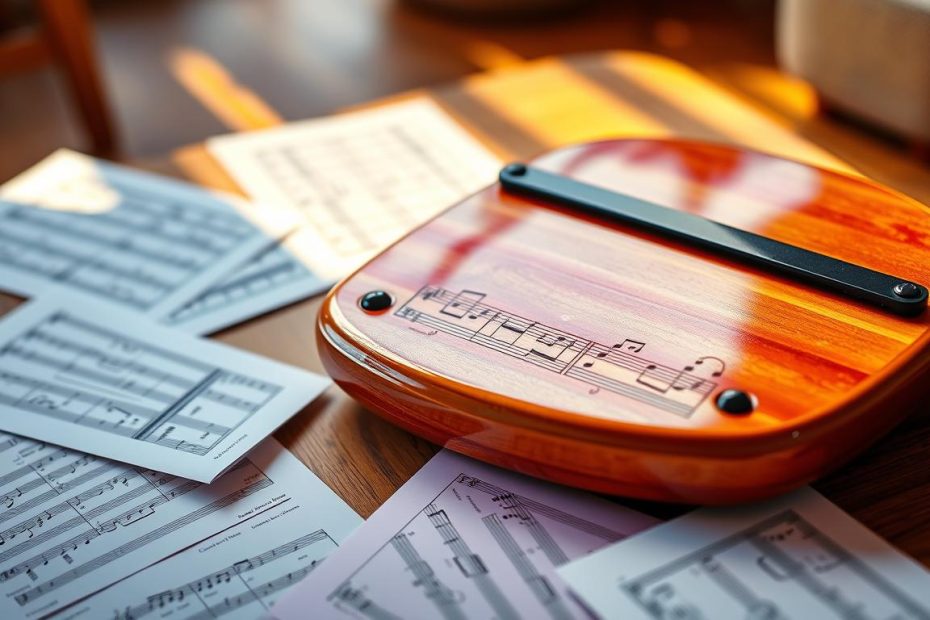
Quick guide for beginners who want to start making music without learning complex music theory.
This guide explains how simplified sheet music and numbered notation (1 = C, 2 = D…) let you play familiar tunes quickly.
The focus is on playing right away: short exercises, visual cues, and stickers for the instrument make the notes easier to remember.
You will find free resources (PDFs, tutorials, and sites such as Instruments du Monde and TongueDrumTunes) to compare and print materials.
After just a few sessions, the method helps you play popular melodies, build confidence, and improve your concentration and visual memory, as Emmanuel Bigand (CNRS) points out.
Introducing the tongue drum and the aim of this guide
This small steel instrument, created by Dennis Havlena in 2007, makes it quick and easy to start making music.
With 6 to 17 tongues and a sustain of 8 to 12 seconds, it has a gentle, soothing sound. In France, brands such as Beat Root and Zenko offer models suited to beginners.
The aim of this guide is simple: to help you learn easy melodies from clear sheet music. It combines NMCA numbered notation (C = 1, D = 2…), note stickers, and short exercises for every level.
“Sheet music gives structure to learning and visual memory.”
This approach favors learning step by step, with practical goals: reading a score, keeping the tempo, and improving rhythmic accuracy.
- An intuitive, soothing instrument that is ideal for beginners.
- The role of sheet music: guiding your hands and reducing mistakes.
- Online resources (Instruments du Monde, YouTube, Pinterest) to expand your repertoire.
For a guided first session, see this beginner lesson and start playing today.
Understanding the melodic instrument: tongues, scales, and resonance
Before you play, get to know how your instrument is built and how it sounds. A steel tongue drum generally has 6 to 17 tongues cut into a steel shell. Each tongue produces a note in a chosen scale.
Sustain ranges from 8 to 12 seconds. Because notes ring out, you need to manage overlapping sounds and dampen them when necessary. Major, minor, and pentatonic scales are the most common; the key changes the music’s character.
To get started, a 9- or 10-note model in C major with clearly marked tongues makes learning easier. In France, consider brands such as Beat Root or Zenko for their tuning stability and value, especially compared with handpans.
To improve sound quality, raise the instrument slightly, avoid soft surfaces, and choose a suitable room: a dry-sounding room for practice or a more open space for projection. Gentle cleaning and protection from moisture help preserve its tuning and tone.
Sheet music notation systems: numbers and letters
Understanding how to read the symbols helps you avoid octave mistakes and follow a melody more easily.
NMCA numbered system: 1 = C, 2 = D, 3 = E, 4 = F, 5 = G, 6 = A, 7 = B. Octaves are often shown with dots or asterisks (for example, 1° for a high note and 1. for a low note). This intuitive system lets you play without learning complex music theory.
The main rhythm symbols are dashes to extend notes, dots to add half a note value, and bar lines to organize measures. A simple example: 1-2-3-1 = C-D-E-C.
Letter notation: C, D, E, F, G, A, and B are the note names from C to B. Charts often match NMCA notation with CDEFGAB notation so you can move between the two methods.
To save time, put stickers on the tongues and use online note conversion charts.
“Connecting numbers and letters makes scales easier to understand and helps you transpose into different keys.”
How to read tongue drum sheet music step by step
Start by reading from left to right, spotting repeated patterns, and noting the bar lines that divide the measures.
Visual cues: scan the line, look for recurring sequences, and mark them in pencil. Repetition gives you useful landmarks.
Note lengths and symbols: a dash extends a note, while a dot adds half its value. Vertical bar lines divide the time into measures.
Tempo: set a metronome to 60 BPM, then increase the speed gradually. Count “1-and-2-and” aloud to internalize the rhythm.
Beginner tip: add stickers and make a key showing 1 = C, 2 = D… This helps you quickly connect each number with a note.
For a closer look at reading music and a detailed example, see this notation guide.
- Break the piece into short, two-measure loops.
- Write fingerings and hand changes directly on the page.
- Count aloud to improve accuracy.
| Element | Symbol | Action |
|---|---|---|
| Extension | – (dash) | Hold the note for one additional value. |
| Half value | . (dot) | Add half the duration. |
| Division | | (bar line) | Divide the measures to make learning easier. |
Getting ready to play: position, hands, mallets, and accuracy
Good instrument placement improves the clarity and projection of the sound. Set it on a stable support and tilt it about 45° to direct the sound toward the listener.
Alternating hands and touch. Alternate your right and left hands to play more smoothly and avoid fatigue. Try playing with your bare hands first, then with felt mallets: mallets increase volume and accuracy, while hands produce a warmer touch.
Protect your fingers during long sessions to keep your movements consistent. Learn to dampen certain tongues to control resonance and prevent sounds from overlapping.
- Place the instrument on a stable support and tilt it for a clear sound.
- Alternate hands for steadier playing and smoother measure changes.
- Choose bare hands or mallets according to your comfort and the sound you want.
- Use finger protection during extended practice.
- Mark fingerings on the sheet music and find where to strike for an even sound.
- Make short recordings to assess tone and balance, then adjust your posture.
Practice rhythmic patterns in short loops to strengthen coordination and consistency. This simple method quickly improves your learning and makes your playing more cohesive.
Easy tongue drum sheet music: 5 familiar melodies
Learn five classic tunes to strengthen your rhythm, fingering, and listening skills. These short pieces are perfect for 10- to 15-minute sessions.
Happy Birthday
Start at around 80 BPM. Suggested opening sequence: 1-1-2-1-4-3 (NMCA). Practice stressing the right syllables to bring the phrase to life.
Frère Jacques
Canonical pattern: 1-2-3-1 / 1-2-3-1 / 3-4-5 / 3-4-5. This piece is ideal for alternating hands and keeping a steady tempo through repetition.
Au clair de la lune
A pattern in 2/4. Use a metronome to smooth the transitions between repeated notes and keep the rhythm steady.
Ode to Joy
Practice the ascending passage in a major scale. Focus on neighboring notes and making each note clear.
Amazing Grace
Focus on dynamics, rests, and connected notes. Mark breaths and fingerings on the score to play more fluidly.
- Identify your instrument’s key and adapt the numbers if needed.
- Practice four measures at a time, then join the sections together.
- Mark fingerings and pauses to make your performance more consistent.
| Piece | Key tip | What to practice |
|---|---|---|
| Happy Birthday | 80 BPM, accents | Accents and opening phrase |
| Frère Jacques | Canon, alternating hands | Repeated loops |
| Au clair de la lune | 2/4, metronome | Even transitions |
| Ode to Joy | Major scale | Ascending passage |
| Amazing Grace | Dynamics and rests | Expressive flow |
To learn more about reading music and adapt numbered sequences to your instrument’s tuning, see this notation guide.
Rhythm, meter, and tempo: playing in time
Mastering rhythm changes how a musical phrase is played and heard. Always begin slowly to establish a steady beat.
Using a metronome
For effective practice, start at 60 BPM, then gradually increase to 120 BPM according to your level. Raise the tempo in steps and repeat each step until it feels comfortable.
Building a steady beat
Time signatures shape musical phrases: 4/4 provides regularity, while 2/4 creates a stronger sense of motion. Bar lines make the divisions easier to see.
- Set a rhythmic framework: begin slowly, then speed up in a controlled way.
- Practice accuracy: count “1-and-2-and-3-and-4-and” to coordinate your eyes and hands.
- Use visual cues: highlighters or vertical lines can divide phrases into sections.
- Adjust your touch and dynamics to the tempo to preserve the sound quality of your instrument.
- Try subdivisions (eighth notes and quarter notes) to improve flow and consistency.
Assess your progress: when playing feels natural and accurate, increase the tempo slightly and check the notes of the scale and your positioning again. This practice makes your playing more musical and reliable.
Online resources for free sheet music
To expand your practice, several platforms offer downloadable resources organized by level. These tools help you choose suitable pieces and progress quickly.
Specialist sites
Start with Instruments du Monde, TongueDrumTunes, and DrumSheetMusic. These sites offer PDFs, difficulty ratings, and focused exercises.
Communities and social networks
Join groups such as “Tongue Drum France” on Facebook, explore Pinterest boards, and take part in active Reddit communities. Feedback from other players can give you new arrangement ideas.
Tutorials, PDFs, and good habits
Download printable files so you can mark fingerings and dynamics. Always check your instrument’s key and whether the numbered notation fits, to avoid transposition errors.
- Filter searches by level and style to choose pieces that suit you.
- Record your practice versions and compare them with tutorials.
- Laminate sheets for rehearsals and outdoor performances.
For a collection of downloadable scores, browse this free sheet music and find pieces suited to your level.
Common mistakes and how to avoid them
Many learners run into simple mistakes that slow their musical progress. Spotting these problems early saves time and improves the accuracy of your playing.
Striking too hard reduces note clarity and can put the instrument out of tune. Control the force of each strike and vary your touch according to where you play.
Confusing octaves (for example, a low D and a high D) changes the melody. Check the key to octave symbols (dots and asterisks) before each session.
Unsteady tempo and misplaced stickers
Without a metronome, the tempo can become uneven. Practice in short, regular sessions to strengthen your sense of the beat.
Misplaced stickers create unhelpful habits. Line them up with the note map and check their positions whenever you change keys.
“Mindful repetition matters more than speed: it is better to play slowly and cleanly.”
- Check that the key of the sheet music matches your instrument before practicing a piece.
- Practice difficult transitions slowly, then increase the tempo gradually.
- Write corrections directly on your sheets to build good habits.
| Mistake | Cause | Solution |
|---|---|---|
| Striking too hard | Tension or trying to play louder | Control your touch; use softer mallets |
| Confusing octaves | Misreading the symbols | Check the key and mark the octaves |
| Unsteady tempo | Not using a metronome | Short sessions with a metronome |
| Misplaced stickers | Incorrect visual cues | Reposition them using the note map |
For practical tips and a clear notation chart, see this reading guide. It helps beginners check notes and placement before learning a piece.
Progress quickly: a practice routine and structured learning
Twenty well-planned minutes a day can bring noticeable progress in three weeks. Follow a simple structure that combines warm-up, technique, and music.
A 20-minute plan: warm-up, technique, and a piece
5 minutes: warm up your fingers and hands by playing simple scales. Play slowly and control each strike.
10 minutes: do focused technical exercises (alternating hands, rhythmic patterns, and accurate notes). Use a metronome to keep the tempo steady.
5 minutes: work on a complete piece, using your marked fingerings and keeping the day’s goals in mind.
- Set weekly goals: the number of measures mastered or a target tempo in BPM.
- Practice with each hand separately to strengthen coordination and consistency.
- Record your progress and difficulties in a practice journal.
Moving on to pentatonic scales and modes (Dorian, Mixolydian)
After two weeks, introduce a pentatonic scale so you can improvise simply and develop your ear.
Then explore modes such as Dorian and Mixolydian to vary the harmonic character. These tools broaden your musical vocabulary and stimulate creativity.
- Start slowly, then gradually increase the tempo.
- Record yourself regularly to assess note clarity and the overall sound.
This short routine makes good use of practice time and suits all levels. After three weeks, focused repetition can produce tangible results.
Composing and writing down your own pieces
Writing your own tunes turns practice into a chance to experiment. Start simply: a rhythmic pattern, a chosen scale, and a clear notation key.
Tools and methods: software, notation keys, and page layout
Choose simple software (such as Notepan) to enter numbers and letters and add bar lines and rhythm symbols. Define a notation key (NMCA and/or CDEFGAB) at the top of the page to make sight-reading easier.
Keep the layout uncluttered, with wide margins, 4/4 measures, and an easy-to-read font. Consult PDF or video tutorials to learn how to lay out your work and export it as a PDF.
From pattern to melody: three chords and variations
Starting with a pattern in 4/4 makes writing approachable. Use the three-chord pattern (C–F–G) as a harmonic foundation.
- Develop a short pattern, repeat it, then vary its ending to create a melody.
- Add connected notes, rests, and dynamics to give it shape.
- Try the score on your instrument, then adjust the fingerings and rhythmic density.
“Testing and revising an idea on the instrument remains the best way to check that it works.”
| Step | Action | Result |
|---|---|---|
| Tool | Enter notes in Notepan | A clear, exportable file |
| Notation key | NMCA / CDEFGAB | Quick reading |
| Checking | Play it on the instrument | Refined dynamics |
Here is a simple example: a C–F–G progression in 4/4, with a repeated rhythmic pattern and two variations at the end. Publish your PDFs and short demonstrations to get feedback and improve your pieces.
Conclusion
This final step shows how practice can become a musical journey. You have explored the instrument, numbered notation, playing position, and the performance of simple melodies.
This guide offers a clear method for reading music, playing, and organizing your routine. Practice for 20 minutes a day with a metronome to make steady progress, whatever your level.
Use sheet music and specialist sites to find resources and pieces for the instrument. Try new scales and keys, and connect with French communities (Beat Root, Zenko) to expand your repertoire.
Enjoy playing. Recording your sessions, listening to them critically, and sharing your progress can help you stay motivated and creative over time.