

Goal: this short comparison helps you quickly identify the key points when choosing an instrument that suits your playing, budget and intended use in France.
Quick background: the handpan has a precisely tuned, hammered steel shell that produces a clear sound rich in harmonics. The tongue drum is a steel body with tongues cut into its surface; it offers deeper, mellower textures.
We will cover construction and materials, tone and volume, notes and playing styles, dimensions and weight, prices and availability, care and accessories. In France, price ranges vary considerably with quality and size.
In brief: the handpan projects more sound, requires more care and generally costs more. The tongue drum is affordable, sturdy and easy to play. Your choice depends on the sound you want, where you will use it and how much time you want to spend on maintenance.
For a detailed guide and examples of models, see our dedicated page: full comparison.
Introducing the two instruments and the purpose of this comparison
Before getting into the details, let us look at their origins and what this guide aims to do.
Both belong to the family of steel percussion instruments. Their rounded shapes can look similar at first glance. One originated in Switzerland around 1999–2000 at PANArt, with Felix Rohner and Sabina Schärer. The other emerged in the United States in 2007, when Dennis Havlena cut a gas cylinder to create the Hank/Tank model.
The main difference is in the playing surface: the handpan has a hammered surface without slots, while the tongue drum has a shell with tongues formed by cutting. This difference in shape affects the timbre, sustain and way each instrument is played.
This article has a simple purpose: to provide a clear guide to construction methods, sound, notes, playing technique, size, weight, price, care and accessories. We will also consider common uses: relaxation, performance, music therapy, learning, improvisation and simple composition.
“These instruments complement each other: one projects sound, while the other charms with its textures.”
| Origin | Surface | Typical use |
|---|---|---|
| Switzerland (1999–2000, PANArt) | Hammered surface, without slots | Performance, meditation, music therapy |
| United States (2007, Dennis Havlena) | Shell with cut tongues | Learning, relaxation, playing on the go |
| The rest of this article compares construction, sound, scales and transport in detail to help you choose between these two sound worlds. | ||
To explore the technical aspects of steel percussion further, see our technical guide.
Design and construction: hammering a handpan and cutting a tongue drum
Construction affects shape, surface and durability.
Handpan — a surface formed by hammering
A handpan consists of two joined metal shells that form a taut playing surface. The central ding and the dimples are shaped with a hammer. Hammering tunes each area, stabilizing its fundamental note and harmonics.
The steel is often nitrided or stainless. Nitrided steel offers desirable sound qualities, while stainless steel resists corrosion better. The process is lengthy: tuning takes time and precision.
Tongue drum — cut tongues and visible slots
The tongue drum is made from a thick steel surface. Cutting with a grinder or laser creates the slots that define its tongues. Their length and shape determine the note and sustain.
Its simple construction makes the instrument sturdy and less prone to going out of tune. Diameters vary widely, often ranging from 15 to 30 cm.
“The construction method shapes the sound: hammering for harmonic precision, cutting for strength and simplicity.”
| Feature | Handpan | Tongue drum |
|---|---|---|
| Process | Hammering dimples | Cutting tongues |
| Material | Nitrided or stainless steel | Thick steel |
| Surface and shape | Smooth playing surface | Open surface with visible slots |
| Durability | Sensitive to impacts and heat | Sturdier, with less maintenance |
Tone and volume: “magical” clarity and a deep, mellow timbre
How each instrument resonates immediately influences where it works best.
The first notable difference is their sound. The handpan produces a clear, enveloping tone. Its melodic timbre is rich in harmonics, with medium to long sustain. Vibrating partials give some notes a singing quality.
The steel tongue drum produces a deeper, softer sound. Its mellow timbre is especially suited to relaxing settings. Its sustain is often very long and may be perceived as less defined, making it suitable for meditation or music therapy.
The handpan generally projects more sound, making it suitable for performances without amplification.
The second instrument excels in small spaces. It suits intimate sessions and can easily be fitted with a piezo pickup or microphone to increase its volume.
“Steel construction and the slots directly affect resonance and the perceived softness of the sound.”
- On stage: the handpan has the advantage in sound projection.
- For meditation: the steel tongue drum has the advantage in softness and sustain.
- Technically: striking technique and room acoustics strongly affect the result.
Notes, scales and playing styles: expression, fingers, hands and mallets
Melodic and rhythmic possibilities depend on the number of notes and the technique used.
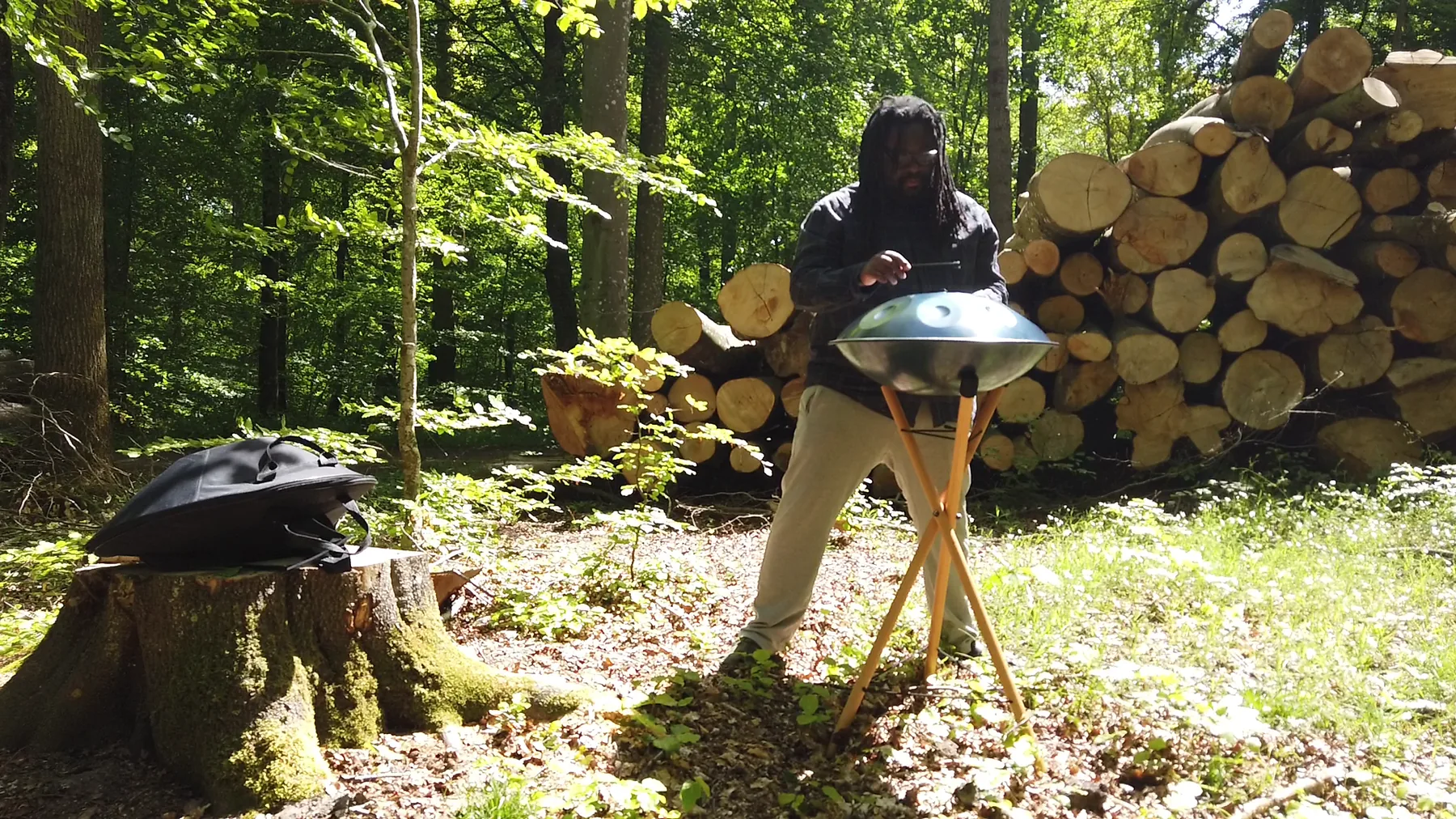
Number of notes: a handpan often has 7 to 10 main notes and may offer additional tone fields, bringing the total to around 21. By comparison, a standard tongue drum generally has 6 to 9 notes.
Musical impact: more notes and registers let you vary intervals and harmonic textures. This makes richer improvisation and more nuanced progressions possible.
Techniques and expression
Players use their fingers, thumbs, knuckles and palms to create subtle percussive effects. Partials tuned through hammering give the handpan expressive finesse, ideal for transitions and ornamentation.
The tongue drum remains intuitive: its notes are often numbered, and striking it with hands or mallets is easy to learn for meditative music.
- Caution: avoid using mallets on a delicate handpan, as they can damage its surface.
- Suitability: mallets work well on a tongue drum when you want more volume.
- Sustain: on a tongue drum, work on articulation and damping; on a handpan, make use of harmonics and ghost notes.
Your choice of repertoire will depend on what you want to play: slow improvisations, meditative accompaniment or more rhythmic patterns.
For guided exercises and scale patterns, see our practical guide.
Dimensions, diameter and weight: transport and comfort
Size and weight directly affect playing comfort, transport and the range of sounds available.
Practical figures: a typical handpan measures about 50 to 55 cm in diameter and weighs between 3 and 8 kg, depending on the steel and construction.
Tongue drums come in a wider range of sizes. Common diameters run from about 15 cm for compact models to around 30 cm for medium-sized ones. They often weigh between 1 and 5 kg.
The handpan’s standardized shape provides a large, stable playing surface. It does, however, need a suitable bag or case for safe transport.
A compact steel tongue drum is easy to carry. It works well for travel, classroom workshops or wellness sessions.
| Instrument | Approximate diameter | Approximate weight |
|---|---|---|
| Handpan | 50 to 55 cm | 3 to 8 kg |
| Small tongue drum | 15 to 20 cm | 1 to 2 kg |
| Medium tongue drum | 25 to 30 cm | 2 to 5 kg |
Diameter affects pitch range: a larger instrument favors lower notes and changes the sustain. Try several sizes to find one that suits your build, intended use and playing comfort.
Prices and availability in France: what to budget
To set a realistic budget, let us compare price ranges seen in the French market and the reasons behind the differences.

Price ranges: in France, a handpan generally costs between €999 and €2,999. Depending on the source, some makers offer models starting at €800 or priced up to €2,500.
The second instrument can be bought for much less. Compact models start at €22.90, and most offerings fall between €50 and €500. Premium versions reach around €600.
Why the difference? A handpan’s higher price reflects its handmade construction, fine tuning and the time required to make it. Size, finish and material, particularly the steel and its treatment, also affect the price of both types.
- Availability: the second instrument comes in a wider choice of models and colors.
- Lead times: orders for handmade handpans can take time.
- Budget: the second instrument can be a first step before a larger investment.
Consider resale value and maintenance costs: retuning may be an additional expense for a handpan.
To complete your research, look at sets and accessories, or try an instrument in a shop. Use our steel tongue drum reference before making your choice.
Care, tuning and resistance to weather
Protecting and caring for these instruments extends their life and preserves their sound while helping you avoid costly adjustments. A few simple steps after each session can limit wear caused by use and weather.
Retuning and caring for a handpan
Sensitivity to impacts and heat.
A handpan’s playing surface can go out of tune after an impact or prolonged exposure to sunlight. If the instrument heats up outdoors, let it cool in the shade before playing again.
Professional retuning may be needed every few years, depending on use. Leave this work to a qualified specialist so you do not damage the instrument by trying to correct notes yourself.
The second instrument’s sturdiness
Simple adjustments and less maintenance.
Made of thick steel, the tongue drum tolerates handling better and rarely goes out of tune. Some models can be adjusted locally, sometimes with a magnet or careful, light sanding.
Routine care often consists of wiping it down, protecting it against rust and checking its rubber feet.
Rust, humidity and salt: precautions
Watch out for humidity and sea air. Nitrided steel can be more vulnerable to corrosion, while stainless steel is more resistant.
Recommended steps:
- Wipe the instrument after use to remove sweat and dust.
- Apply a light protective oil if needed, and store the instrument somewhere dry.
- Use a good case and avoid large temperature changes.
A few minutes of care after each session can considerably extend the instrument’s life and help prevent more substantial work later.
| Consideration | Handpan | Tongue drum |
|---|---|---|
| Sensitivity | Impacts and heat can affect tuning | Sturdier; rarely goes out of tune |
| Routine care | Wiping, light oil, a case and dry storage | Wiping, rust protection and checking the feet |
| Tuning needs | Professional retuning every few years | Local adjustments may be possible with a magnet or sanding |
| Climate | Take care in humidity and salty air | More tolerant, but protection is still recommended |
Accessories and playing positions: stands, cases, tables and laps
Accessories affect how you use the instrument: the right support makes playing easier and protects it.
Feet and stands
For the handpan, dedicated stands include adjustable tripods and supports for playing while seated or standing. They let you adjust the height and angle for more accurate playing.
For the tongue drum, simplicity comes first: rubber feet provide a stable base on a table, or you can play it directly on your lap. Mallets also let you vary the dynamics.
Cases, transport and protection
Choose padded cases that fit the instrument. They protect the steel and playing surface during travel.
Non-slip feet, hard cases and piezo contact microphones can be useful, depending on whether you play in a studio, on stage or in workshops.
Stability affects striking accuracy: a suitable height helps protect your hands and fingers.
| Accessory | Function | Advice |
|---|---|---|
| Adjustable stand | Stability and playing angle | Choose one for the instrument’s size and your comfort |
| Rubber feet | Stable placement on a table | Essential for smaller models |
| Padded case | Protection during transport | Choose the right size |
Long-term protection: avoid rubbing against the tongues and striking the handpan’s surface directly with hard objects. Use a stable table to limit unwanted vibrations.
Your choice of accessories depends on where you play—outdoors, on stage or in a studio—as well as the instrument’s size and intended use. A well-chosen set of accessories improves comfort, longevity and sound quality.
Tongue drum or handpan: differences and which one to choose
To choose between these instruments, focus first on how you will use yours.
Choosing by sound and intended use
Sound: if you want a clear, harmonic-rich sound that carries on stage, the handpan is more likely to meet your needs. For soft, mellow, meditative textures, the tongue drum is often preferred.
Budget, skill level and learning time
Prices in France vary widely: expect to pay around €1,000 to €3,000 for a handpan and roughly €50 to €600 for a tongue drum. The second instrument is quick to get started with; the first takes more practice to make full use of its expressive range.
Environment and maintenance
Durability: the tongue drum’s sturdy construction is an advantage if you travel often. A handpan needs more attention, including professional retuning and care around heat or humidity.
Try several models, listen to recordings and check their comfort, weight and ergonomics before investing.
- Choose according to sound and intended use.
- Consider your budget and the time needed to learn.
- Plan for the playing conditions and maintenance.
Conclusion
In summary, this guide reviews the essentials covered in the article: hammered or cut construction, sound, number of notes, projection, ergonomics, price and care.
The two instruments serve complementary purposes. The handpan offers a clear, expressive sound suited to the stage; the tongue drum offers soft textures, accessible playing and good durability.
Before investing, take time to listen to and try both instruments. Check their sustain, balance and feel. Also think about weight, transport, cases and stands for everyday use.
This guide helps you match your choice to your budget, skill level and intended use. Whichever instrument you choose, practice regularly and follow simple care routines to preserve its timbre.
To explore the subject further, read our full comparison through this link, and take time to listen before buying.