
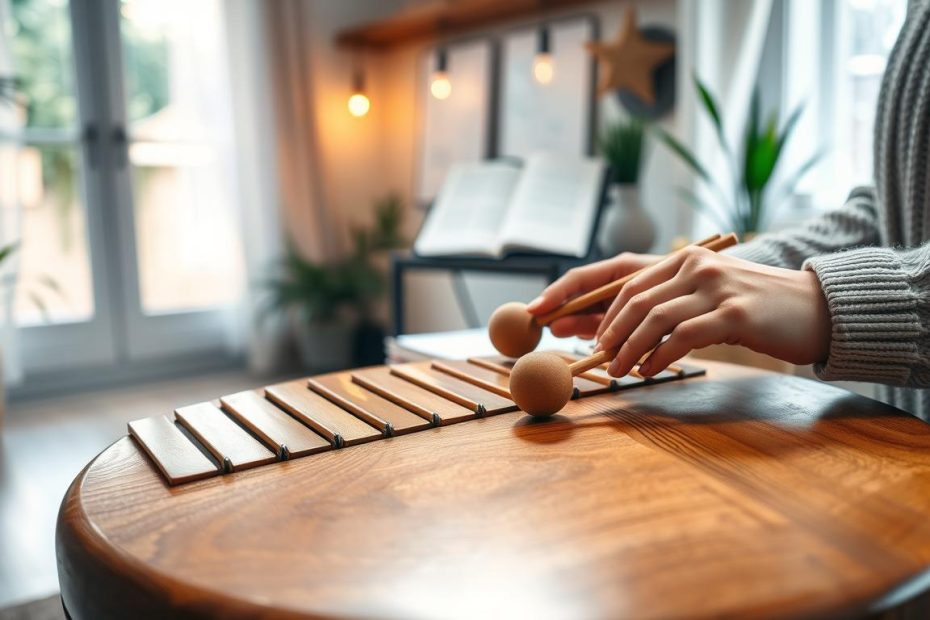
Welcome: this guide introduces an accessible and inspiring instrument. Invented in 2007 by Dennis Havlena using a propane tank, it has a long, warm resonance.
Within minutes, most players can produce their first notes. We help you work through the choice of model, number of notes, scale, and budget step by step.
We also explain when to use sheet music (NMCA or English letter notation) and when to favor pentatonic improvisation. You will find practical advice on sizes, prices, and accessories.
The goal is to make harmonious music without reading conventional notation. We offer a clear roadmap, price guidelines, and online resources, including a selection at Instruments du Monde, to help turn your interest into regular practice.
Why choose this percussion instrument today
This instrument is popular today for its simplicity and its ability to create a calming atmosphere straight away.
Accessibility and immediate enjoyment: the tongue drum is quick to learn. 95% of people produce their first notes within 15 minutes. Its resonance (8 to 12 seconds) creates enveloping sounds and melodies that encourage relaxation.
Cost and quality: at a price 3 to 10 times lower than a handpan, it offers a way into music without compromising on quality. French brands such as Beat Root and Zenko offer reliably tuned models and useful accessories.
Uses and benefits: popular in meditation, music therapy, and early music education, this instrument helps manage stress and improve concentration. Its portability encourages short, regular sessions.
- Easy to learn and make progress with sheet music and a clear method.
- Versatile uses: relaxation, yoga, sound therapy, or creative playing.
- A reasonable investment: try it before moving on to other models.
| Criterion | Benefit | Example |
|---|---|---|
| Accessibility | Quick to learn | 95% play their first notes within 15 minutes |
| Price | Affordable | 3 to 10 times cheaper than a handpan |
| Applications | Relaxation and therapy | Yoga, music therapy, meditation |
| Brands | Availability | Beat Root, Zenko |
To learn more, read our complete guide and choose the model that suits the way you want to play.
Understanding the tongue drum: steel, tongues, and notes
Its structure and materials determine the character and sustain of its sound.
Clear definitions: steel tongue drum, hank drum, and tongue drum all refer to the same modern percussion instrument. It is an idiophone: sound comes from the vibration of the instrument itself.
The shell is usually made of thick steel. Cuts in the shell form flexible tongues. Each tongue corresponds to a note.

Pitch depends on the tongue’s length, width, and mass. The sound sustains for a long time, generally 8 to 12 seconds, creating layers of sound ideal for slow patterns.
Some models let you adjust the tuning with small magnetic weights placed beneath the tongues. Wooden versions have a drier tone and can be useful for teaching.
- Material: treated steel for sound projection and stability.
- Role of the tongues: determine the pitch and tone.
- Playing technique: strike gently with a finger or hand to produce a clear sound.
| Component | Effect on sound | Note |
|---|---|---|
| Steel | Projection and long resonance | Resists corrosion if treated |
| Tongues (6 to 17) | Determine the available notes | More tongues = a wider range |
| Tuning magnets | Allow fine tuning | Useful for adjusting pitch accuracy |
Define how you want to play: sheet music or intuitive improvisation
Choosing between reading music and improvising clarifies your learning path and guides your choice of model.
Play from sheet music to structure your learning
Sheet music often uses NMCA numbered notation (1 = C, 2 = D…) or letter notation (C, D, E). It provides a progressive method and strengthens visual memory.
“Reading music stimulates cognitive functions that support memory and attention.”
Improvise in a pentatonic scale to free your creativity
A pentatonic scale is forgiving: it lets you improvise without hitting a wrong note. For beginners, numbered stickers on the tongues make it easier to get started.
How this affects the number of notes and your choice of model
- Sheet music → more notes, a wider range, and rhythmic precision.
- Improvisation → fewer notes, fluid playing, and exploration of sound and resonance.
- Alternate guided and free sessions to speed up learning.
| Approach | Benefit | Effect on instrument choice |
|---|---|---|
| Reading sheet music | Method and reference points | 13 to 15 notes recommended |
| Pentatonic improvisation | Creativity and simplicity | 8 to 10 notes are enough |
| Combined approach | Progress and enjoyment | Choose a versatile scale |
For online resources and tutorials that make practice easier, see our guide to structured learning.
How many notes should you choose for your playing style?
How you want to play determines the best balance between range and ease of use.
For sheet music: the flexibility of 13 to 15 notes
13 to 15 notes cover most sheet music. A piece written for 13 notes can still be played on a 15-note instrument, but the reverse is often impossible.
This range gives you more harmonic freedom without making the layout too complicated. If you are unsure, a 15-note model will generally spare you another purchase soon afterward.
For intuitive playing: 8 to 10 notes are often enough
For improvisation, 8 to 10 notes make it easier to find your way around the instrument and play instinctively. Small models (20 to 25 cm) are light and affordable, sometimes costing less than €100.
- Size and number of notes: more notes mean a larger diameter.
- Ease of use: fewer notes make the layout easier to remember.
- Combined approach: 12 to 13 notes offer a good balance between sheet music and improvisation.
Decide first whether reading music or improvising matters more to you, then adjust the number of notes and your budget to avoid frustration. For a complete guide, see our tongue drum guide.
Scales and keys for a good start
The scale you choose affects both your immediate comfort and how you learn.
C major or F major are ideal keys for reading sheet music. They offer a wide repertoire and progressions that sound familiar. They make patterns easier to learn and help you gain confidence in reading music sooner.
Simple scales for improvisation
For improvisation, consider Amara or D minor. These scales provide harmonic space and natural melodic paths.
- Consistency: stay with one scale at first to train your ear and memorize the note positions.
- Tuning: choose an instrument tuned at the factory; models with magnets allow small adjustments.
- Listening experience: major scales suggest energy, while minor scales suggest introspection and meditation.
Explore different sounds
Akebono, Hijaz, and Pygmy offer distinct musical colors. Try them after you have mastered a main scale; they broaden your palette and encourage creativity.
A simple plan: start with a major scale for reading music, add a minor scale for improvisation, then experiment with other sounds. For practical resources and suitable models, read our guide to getting started with the tongue drum.
Budget and quality: how much should you spend at first?
Spending sensibly at the start helps you enjoy playing and learn faster. Aim to buy an instrument costing between €100 and €300 while you explore it; if you are unsure, do not spend more than €500.
Small steel models (around 20 to 25 cm with 10 notes) remain affordable.
Look for a complete set: mallets, a French-language booklet, stickers to identify the tongues, and silicone finger protectors. Choose models that come with tutorials and a few pieces of sheet music so you can get started easily.
Quality steel and a corrosion-resistant finish extend the life of the instrument. A gentle wipe with isopropyl alcohol is enough for maintenance. Brands such as Beat Root and Zenko, along with the Instruments du Monde store, offer reliable options.