
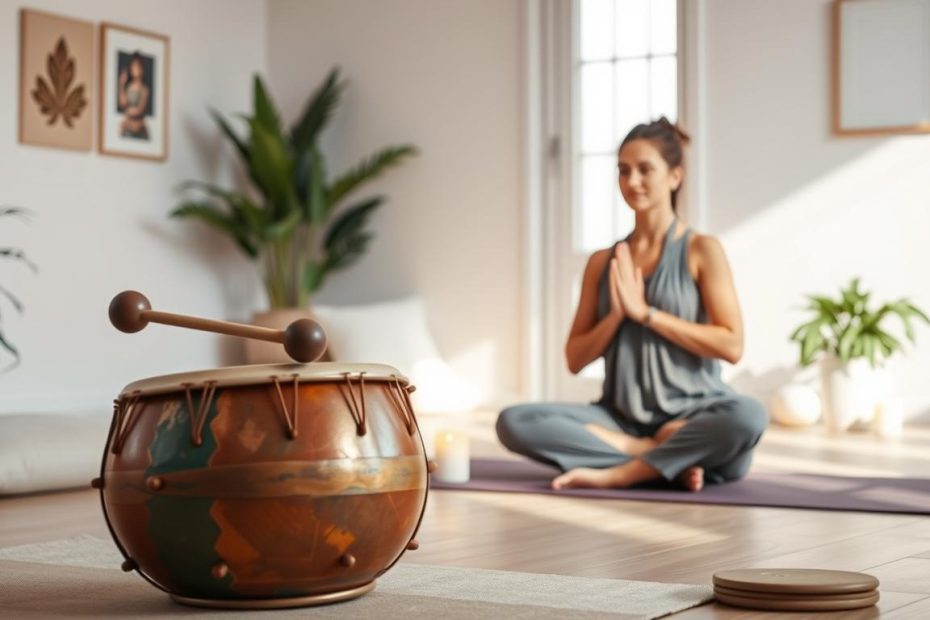
This guide explains step by step how to incorporate a simple melodic instrument into a deep meditation session. The aim is to offer a calming experience accessible to beginners and experienced practitioners alike.
The drum produces sounds of around 70 to 80 dB. Models tuned to 432 Hz and a pentatonic scale make intuitive playing easier. Regular practice may reduce anxiety by nearly 40%.
We explain how to prepare your space, follow a gradual routine, choose rhythms and select equipment. Each step provides clear guidance on duration and tempo to avoid overstimulation beyond 20 minutes.
Expected benefits: better sleep quality, reduced stress and improved concentration. Safety comes first: start gently and adjust your playing to how you feel.
Understanding the Connection Between Yoga Nidra, Musical Meditation and the Tongue Drum
The slow, low-pitched music of this instrument creates a setting suited to mindful relaxation.
Definition and role: yoga nidra is a guided relaxation practice based on focused attention. Meditation and music serve as anchors. Steady sounds help maintain concentration and reduce mental distraction.
Soothing Vibrations for Harmony of Body and Mind
The tongue drum’s vibrations envelop body and mind. Its broad tongues produce low notes that encourage calm and lasting muscle relaxation.
Brain Waves, Stress and Deep Relaxation
Slow rhythms and low frequencies shift brain waves toward alpha and theta states. A study published in PLOS One in 2013 reported a 27% drop in cortisol after 15 minutes of listening to low frequencies.
Contemplative Listening and Listening for Entertainment
Contemplative listening engages sustained attention and reduces cognitive load. Listening for entertainment, by contrast, stimulates and scatters attention.
- Recommended practice: soft sounds, gentle strikes and long resonances.
- Accessibility: built-in tuning and a short learning curve.
- Tongue drum tuned to 432 Hz: a tuning often chosen for relaxation.
Preparing Your Space, Body and Mind for a Sound-Based Yoga Nidra Session
Settle into a quiet, comfortable place before beginning the session. The 3Cs—comfort, calm and concentration—provide a framework for this preparation. For comfort, use a mat, an ergonomic cushion and a blanket.
For calm, turn off phones to reduce distractions and use curtains to help manage the acoustics. For concentration, choose soft lighting and a visual focal point or a discreet metronome to keep the tempo steady.
Choose a pain-free position: modified lotus, a chair or an exercise ball, depending on your needs. To play, rest the drum on your thighs or a stable surface. Place pads underneath it to prevent unwanted vibrations.
Before striking any notes, spend 2 to 3 minutes on 4-7-8 breathing: inhale for 4 counts, hold your breath for 7, then exhale for 8. This routine lowers arousal and brings the body into sync.
- Practical tips: use slow rhythms.
- Do a brief body scan to adjust your position and tempo according to how you feel.
- Set an intention for the session and prepare a selection of low notes to use.
How to Use a Tongue Drum for Yoga Nidra
Before playing a note, decide what you want to bring into your practice. State a clear intention—such as easing anxiety or improving sleep—then do a brief body scan, focusing on each area for 30 to 60 seconds.
Opening Step: Intention and Body Scan
Opening: say your intention quietly and move your attention through your head, shoulders, chest, pelvis and legs. This prepares body and mind for the session.
Drum-Guided Breathing Phase (Gentle Breath Coordination)
Recommended duration: 5 minutes. Gently strike a low note with each breathing cycle. You can use 4-7-8 breathing, counting the strikes to synchronize breath and sound.
Rotation of Awareness: Low Notes and a Slow Rhythm
For 8 to 10 minutes, direct your attention to each part of your body in turn while playing slow, synchronized strikes.
Visualizations and Mantras: Hypnotic Repeating Patterns
Use looping patterns of three pentatonic notes, for example, and alternate between two or three simple visualizations. Repetition acts like a sonic mantra, helping you settle into a deeper state.
Closing the Session: A Gradual Return and Integrating Silence
Finish with a transition: increase the tempo very slightly and move up one note, then slow down into silence. Allow 60 to 90 seconds without sound to settle into the experience.
Example sequence: 3 minutes of intention and breathing, 8 minutes of rotating awareness and playing patterns, then 3 minutes of returning and resting in silence. For more details, see this practical tongue drum guide.
Rhythms, Notes and Playing Examples to Encourage the Nidra State
A measured tempo makes your playing a steady support for relaxation.
Choosing the right tempo
Aim for 40 to 60 BPM: slow rhythms reduce anxiety and encourage a shift toward alpha and theta brain-wave states. A visual metronome helps you maintain a consistent tempo.
Simple Progressions on a Pentatonic Scale
Favor a repeating three-note pattern (1-3-5). The pentatonic scale makes each sequence sound harmonious, even when you improvise.
- Pattern 1: one long note every 2 to 3 seconds.
- Pattern 2: a slow 1-3-5 pattern repeated at 50 BPM for 2 minutes.
- Suggested sequence: low, low, middle, then back to low.
Common Mistakes to Avoid
Take care: an uneven tempo, excessive volume and too many melodic changes can break the relaxed state. Avoid strikes too close together, which obscure the resonance.
“Repeating patterns steady attention; consistency matters more than virtuosity.”
A concrete example: play three notes (1-3-5) at 50 BPM for 5 minutes, add a fourth passing note for 5 minutes, then return to the original pattern for 3 minutes. Start with 10 to 15 minutes and do not exceed 20 minutes without a break.
Choosing and Setting Up an Instrument for the Practice
A well-tuned instrument makes every strike a reliable support for relaxation.
Pentatonic or diatonic: a pentatonic scale has five notes and allows intuitive playing without dissonance. A diatonic scale has seven notes; to imitate a pentatonic scale on an instrument tuned in a major key, mark and skip degrees 4 and 7, F and B.
Tuning frequency: 432 Hz encourages relaxation and a sense of harmony in the body. The 440 Hz frequency remains the standard for playing with other instruments. Try both and notice how your body responds.
Size and materials: a diameter of at least 30 cm produces deeper low notes and more noticeable vibrations. Choose 6 to 11 notes for a balance of simplicity and sonic variety.
- Materials: steel for clarity and durability; carbon if you want a lighter instrument.
- Quality: check the tuning, the consistency of the tongues and the stability of the pads.
- Finish: a smooth surface and felt-covered mallets reduce finger noise.
| Feature | Impact | Recommendation |
|---|---|---|
| Scale | Influences harmonic combinations | Pentatonic for meditation; diatonic if you want to adapt it |
| Tuning frequency | Physical sensation and compatibility | 432 Hz for relaxation; 440 Hz for ensemble playing |
| Diameter & number of notes | Depth of low notes and range of sounds | At least 30 cm and 6 to 11 notes |
| Materials | Resonance and weight | Steel for clarity; carbon for easier transport |
To explore the effects of 432 Hz further, read an article about the benefits of 432 Hz. Plan to get a suitable case and try the instrument in a store before buying it.
Accessories and Quality Tips for a Smooth Experience
Suitable accessories help produce a consistent sound and improve listening quality. They make practice easier and protect your instrument between sessions.
- Felt-covered and silicone mallets for gentle or more percussive strikes.
- A padded case that protects against knocks, with pockets for accessories.
- A discreet visual metronome, either an app or a device, for maintaining slow tempos.
- Finger rings to improve accuracy and control of your touch.
Care and Tuning: Preserving Clarity of Sound
After each session, wipe the instrument with a microfiber cloth. Store it away from moisture and sudden temperature changes.
Use a tuning app occasionally to check that the notes remain stable. For bare steel, a light rust-prevention spray can be useful; always follow the manufacturer’s instructions.
Quality, Transport and Support
Check that there are no buzzing sounds and that the tongues sustain their notes for a similar length of time. These checks help ensure a consistent, high-quality sound.
- A stable stand and a foam mat limit unwanted vibrations.
- A case with comfortable straps and a label showing the diameter and model helps you transport the instrument safely.
| Accessory | Benefit | Buying tip |
|---|---|---|
| Felt-covered or silicone mallets | Gentle or defined strikes and a rounded sound | Choose soft heads for relaxation sessions |
| Padded case | Protection against knocks and moisture | Internal pockets for mallets and app devices |
| Visual metronome | Steady tempo without additional noise | A discreet app or LED device |
| Tuning app | Checks note stability and allows quick adjustments | Try it before buying and calibrate it to your chosen tuning frequency |
In summary: good accessories simplify playing and noticeably improve the experience. For practical advice on technique and getting started, read a guide to playing techniques.
Making the Practice a Habit: Adding It to Your Routine
Adding short sound sessions to your day helps establish a beneficial habit. A little time is enough: regular short sessions create a routine that is accessible and sustainable.
Daily Short Sessions and Focused Rituals
Seven minutes can produce measurable effects. Schedule one or two 7- to 10-minute sessions each day to establish the practice without pressure.
- Morning: 3 minutes of freely chosen notes for a gentle start, then 2 to 4 minutes of a simple pattern.
- Midday: 4 minutes on a single low note to refocus before continuing your day.
- Evening: a slow pattern alternating light and firm strikes to mark the transition to rest.
Tracking Sessions: Journal, Intentions and Needs
Keep a session journal: note your intention, duration, tempo, favorite notes and how you felt before and after playing. This record makes progress more visible and helps you adjust the practice to your needs.
- If you feel agitated, slow the rhythm and simplify the patterns.
- If you become too drowsy, increase the tempo slightly or shorten the session.
- Plan one longer session of 15 to 20 minutes each week to deepen the experience.
“Consistency matters more than intensity; a short daily ritual transforms the quality of meditation.”
For a practical guide and example sequences, read about tongue drum meditation.
Expected Benefits: Relaxation, Concentration and Well-Being
Regular use of this musical instrument has measurable effects on stress and sleep. Studies report lower cortisol after 15 minutes of listening to low frequencies and a reported reduction in anxiety of nearly 40% with continued practice.
Reducing Stress and Improving Sleep
During a session, low notes and long resonances help reduce tension. Synchronizing your breathing with the rhythm makes it easier to relax your muscles and fall asleep sooner.
Simple evening rituals built around slow patterns improve sleep quality for most practitioners.
Theta Brain Waves and Emotional Balance
Repeated research has shown an increase in alpha and theta brain waves after a session. This encourages greater emotional stability and better concentration during the day.
- Look for a noticeable reduction in stress as your nervous system settles.
- Notice your muscles relaxing and your breathing becoming fuller.
- Use this instrument as a gentle way to bring mind and body into harmony over time.
“Low sounds and widely spaced notes encourage calm; include pauses of silence to strengthen neural integration.”
Conclusion
A structured ending reinforces relaxation and eases the transition back to daily life. Prepare your space using the 3Cs, breathe deeply, play low notes and repeat slow patterns, then finish with a period of integrating silence.
Summary of benefits: this approach combines measured rhythms and enveloping vibrations to encourage relaxation, reduce stress and improve sleep. The tongue drum makes meditation accessible.
Start with short sessions, keep the tempo steady, note how you feel and adjust the drum’s diameter, mallets or tuning frequency (432 or 440 Hz). Favor a pentatonic scale, prioritize regularity over session length and combine this method with other gentle practices to enrich the experience and encourage mental balance.