
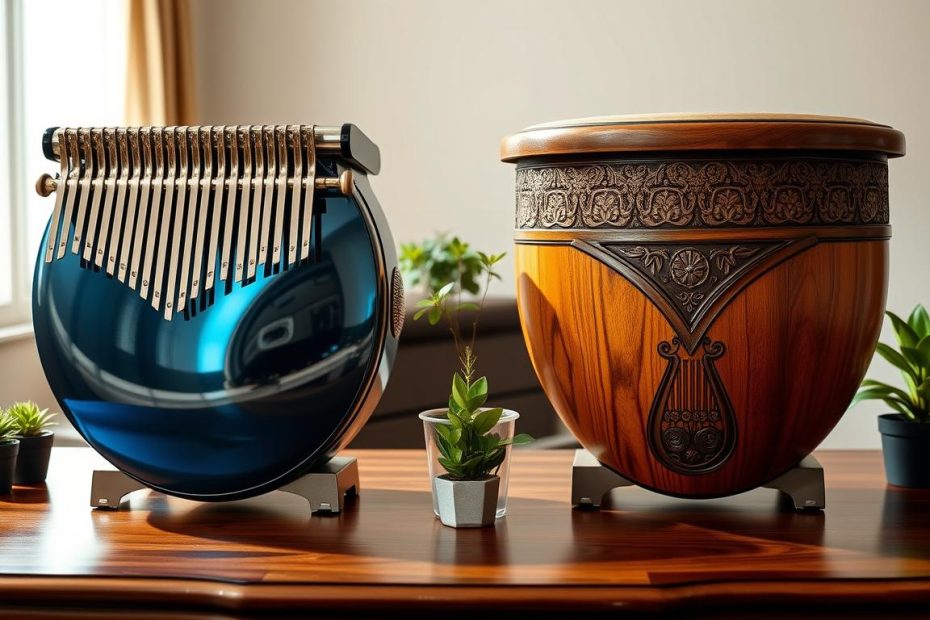
Why compare compact 8-note and 11-note instruments today? People use them for everything from meditation and music therapy to improvisation and playing from sheet music. This choice affects the playing experience, resonance, and budget from the moment you buy.
Each tongue produces one note: more sounds expand your melodic possibilities but make learning and playing more complex.
This guide explains the practical difference between 8 and 11 notes, helps beginners, musicians, and children choose, and connects different uses to models according to their scale and tuning.
Key considerations from the outset: body size (its effect on sustain, bass, and portability), materials (steel, stainless steel, aluminum), and tuning (440 Hz for playing with others, 432 Hz for relaxation).
As a reminder, small models (25 to 30 cm, around 2 kg) are portable and higher pitched; large ones (up to 45 cm, 5 kg or more) offer deeper bass.
We will first look at the number of tongues and the available scales, then cover sound, learning, materials, ergonomics, budget, and practical uses. The right choice depends on your style, skill level, and budget.
Understanding the number of tongues: 8 notes or 11 notes
One tongue corresponds to one note: each cutout in the metal produces a specific pitch. An instrument with eight playing areas offers eight different pitches, immediately defining the musical range available to you.
Typical ranges: beginner models often have between 6 and 11 tongues. They reduce the chance of playing notes that clash and make improvisation easier. Versions with 12 or 15 tongues suit players seeking more harmonic possibilities and wanting to play countermelodies.
Pentatonic scales (five tones) avoid semitones and produce a harmonious sound. A diatonic scale (seven tones) lets you play familiar tunes and follow sheet music more closely.
More tongues extend an instrument’s range, but finding the right notes requires greater precision. Ergonomics matter too: alternating your right and left hands helps patterns flow across eleven playing areas.
For a closer look at choosing a scale and key, read our guide to scales and keys. Understanding note counts and scales prepares you for the comparison between 8 and 11 notes below.
8-Note or 11-Note Tongue Drum: Which Is Better?
Choosing between a compact and an expanded format means deciding whether simplicity or melodic range matters more to you. Here are practical criteria to guide your choice according to your experience and intended use.
Key criteria
Simplicity makes hand placement easier and limits mistakes. A smaller model is easier to learn on.
A wider melodic range allows diatonic passages and faithful renditions of familiar tunes. It calls for greater accuracy when locating the tongues.
Who each format suits
For children and beginners: choose a pentatonic instrument. It helps develop coordination and reduces notes that clash.
For experienced musicians: a larger format opens up diatonic scales and modes such as Amara, Akebono, and Hijaz.
Typical uses
- Meditation and music therapy: a pentatonic scale encourages relaxation.
- Improvisation: it flows well on either format, depending on your style.
- Sheet music and covers: a greater number of notes offers an advantage.
“Start simply, then broaden your range when you want to play from sheet music.”
| Criterion | Compact format | Expanded format |
|---|---|---|
| Simplicity | Very approachable | More demanding |
| Melodic range | Limited; ideal for simple patterns | Broad; better suited to sheet music |
| Recommended use | Meditation, beginners | Compositions, covers |
| Portability | Very good | Less convenient |
To make a choice that suits your progress, start with a small format, then move to a larger one to enrich your melodies and play from sheet music. See our buying guide for practical advice too: how to choose your instrument.
Sound and resonance: the impact of diameter and sustain
The size of the body changes how each note resonates and how long it lasts. Diameter plays a key role in sound and resonance: a larger surface generally produces stronger bass and longer sustain.

Small formats (25 to 30 cm)
25 to 30 cm, around 2 kg: these models produce clear, higher-pitched sounds. They are well suited to travel and sessions away from home.
The attack is distinct, but projection remains limited. The tongues are closer together, so imprecise playing can cause interference and unwanted overtones.
Large formats (35 to 45 cm)
35 to 45 cm, 4 to 5 kg or more: the wider body allows lower notes. Resonance lasts longer (up to around 10 to 12 seconds) and fills a room or outdoor space more effectively.
These formats suit meditation, yoga, and ambient music thanks to their greater projection and rich overtones.
In practice, if you will play both at home and while traveling, aim for around 35 cm to balance portability, sound, and sustain. A large-diameter model with fewer notes will often sound deeper than a small model with many notes.
“Diameter shapes the character of the sound just as much as the number of notes.”
For help choosing a size, read our guide to choosing the right size.
Available scales: pentatonic, diatonic, and specific modes
Choosing a scale means choosing a palette of moods and tonal colors. It influences your style, intended use, and access to melodies.
The pentatonic scale (five tones) is intuitive. On a compact pentatonic instrument, your melodies remain harmonious. It suits meditation and music therapy because it avoids semitones and reduces notes that clash.
An expanded format tuned diatonically gives you the seven traditional scale degrees. With eleven playing areas, you can follow sheet music in C major, D major, or D minor and play familiar tunes. For example, a diatonic model in C major makes nursery rhymes easier to play.
Among the modes, Amara (Celtic) is gentle and harmonious. Akebono sounds more unusual and hypnotic. Pygmy evokes a dreamy mood. Hijaz adds a more expressive, percussive Middle Eastern color. These scales shape the atmosphere you want to create.
In practice: changing the tuning after purchase is difficult. Neodymium magnets can temporarily lower a note, but multi-scale systems are expensive. A material such as steel does not change the scale, though it does affect projection and tone.
To learn more, read our guide to scales and keys.
Learning, sheet music, and group playing
Learning to play starts with choosing a scale that limits mistakes and builds confidence. For beginners, the pentatonic scale is ideal: it removes semitones and reduces notes that clash.
This simplicity speeds up learning. Patterns remain harmonious, progress comes quickly, and motivation stays high.
Playing familiar tunes
A diatonic instrument with eleven playing areas makes it easier to follow sheet music. It supports major and minor melodies and is a better match for tutorials.
Tuning reference and group playing
If you want to play with a guitar or piano, choose 440 Hz: it is the common reference for performances and music teaching. Some people choose 432 Hz for relaxation; its perceived effect is subjective.
- Practical guide: start with 8 pentatonic notes to learn the basic movements.
- Move to 11 notes to play longer, more nuanced pieces from sheet music.
- More playing areas require you to learn where the tongues are and alternate between your right and left hands.
“Start simply, improvise in pentatonic, then work on diatonic pieces from sheet music.”
Suggested practice routine: begin with short rhythmic patterns, gradually add new notes, then work on sheet music and keys to enrich your playing.
Materials and construction: steel, stainless steel, aluminum
The choice of metal shapes the instrument’s voice as much as its size does. Here we compare three common material groups to understand their effects on resonance, timbre, and longevity.
Resonance, timbre, and durability by material
Nitrided steel and mild steel: nitrided steel stands up better to moisture and retains a balanced tone. Mild steel produces rounded, warm notes prized for relaxation.
Stainless steel: it resists corrosion well and produces a clear, bright timbre. It is ideal for outdoor playing without worrying about rust.
Aluminum: it is very light, with higher-pitched sounds and shorter sustain. It is convenient for travel and percussive rhythms.
Care and resistance to outdoor conditions, moisture, and travel
- Metal thickness and build quality affect tuning stability and projection.
- A padded case and a wipe-down after every session extend the instrument’s life.
- Avoid impacts and prolonged exposure to moisture; stainless steel requires less upkeep.
Practical tip: consider a nitrided steel model from the outset if you often play outdoors or travel. Good factory tuning remains essential because retuning the instrument is difficult.
“The material does not change the scale, but it strongly colors the sound and feel of playing.”
Playing comfort, ergonomics, and accessories
Playing comfort can turn occasional practice into an enjoyable, lasting routine.
Layout of the playing areas: look for an intuitive arrangement of the tongues. A concentric layout makes it easier to alternate between your right and left hands and helps patterns flow. It reduces mistakes and speeds up learning the notes.
Mallets: choose rubber mallets in different levels of hardness. Soft mallets produce rounded sounds; firmer ones give a crisp attack.
Stands and cases: an adjustable, non-slip stand stabilizes the instrument and improves its projection. A padded case protects it from impacts and moisture, which is essential for travel.
| Accessory | Purpose | Advice |
|---|---|---|
| Layout of the playing areas | Playing ergonomics | Concentric arrangement for alternating hands |
| Mallets | Attack and timbre | Try several hardness levels according to the model and size |
| Stand | Stability and projection | Choose a non-slip, adjustable stand for playing seated or standing |
| Case | Protection | Choose a padded, moisture-resistant case for travel |
Stainless steel resists corrosion better during frequent travel. A large-diameter instrument needs a sturdy stand; a small model remains easy to handle on the move.
“Trying different mallets will help you hear how they affect dynamics, clarity, and sustain.”
A modest investment in these accessories improves precision, extends the instrument’s life, and enriches the playing experience. For a portable model, choose a sturdy case and soft mallets.
Budget and brands: choosing with confidence
Deciding how much you want to spend helps narrow the options and avoid regrets.
Consider models by price range: entry-level instruments for discovering the tongue drum, mid-range ones for reliability, and high-end ones for precise tuning and careful finishing.
High-end brands such as RAV Vast and Zenko offer precise tuning and dependable after-sales service. Others, such as Idiopan and Hluru, offer good value for money.
Why tuning matters: stable tuning helps with accurate pitch, projection, and compatibility with other instruments. Good tuning can be decisive when playing with a group.
- Budget for accessories: a case, mallets, and a stand. Add 15 to 20% to the total cost.
- When buying used, check for rust and dents, and make sure the notes remain stable after repeated strikes.
- Nitrided steel stands up better to weather and wear over time, which helps if you play outdoors.
Practical tip: first decide how you will use the instrument (for meditation or to play from sheet music) to guide your choice. The cheapest model may be tempting but may not last.
“Try instruments and listen to audio comparisons before buying so you can judge how they really sound.”
For a complete buying guide and model recommendations, read our buying guide.
Practical uses and quick recommendations
How you plan to use the instrument often determines the best balance between portability and tonal range. Here are recommendations based on your needs and experience.
Meditation, music therapy, travel, children: how many notes?
Meditation and music therapy: choose a pentatonic scale and a large diameter (35 to 45 cm) for warm resonance and long sustain. A minor key can encourage immersion.
Travel: choose a small diameter (25 to 30 cm), low weight (around 2 kg), and a sturdy case. This format is easier to carry without sacrificing clarity.
Children and beginners: choose a simple instrument (6 to 11 playing areas) to limit complexity and make the notes easier to remember. Move to 11 playing areas if playing from sheet music is also a goal.
When should you choose a smaller format, and when should you move up?
- Relaxation and travel: start with a compact format to learn the basic movements.
- Covers and sheet music: choose an expanded diatonic scale for greater fidelity.
- Style: a smaller format suits a minimalist approach; more playing areas support musical exploration.
Tuning reference: 440 Hz for group playing; 432 Hz if you prefer it for relaxation. To learn more about this tuning, read the analysis of 432 Hz.
“A practical example: a compact pentatonic model for relaxing improvisation; an expanded diatonic model for structured melodies.”
Conclusion
Base your choice on how you intend to play and how you want to progress. 8 notes for simplicity support portability and quick learning, while 11 notes for a wider range offer more melodic possibilities and make covers easier. It is a choice that matters.
Remember: the fundamental note and the number of playing areas shape the instrument’s musical character. Consider the tuning reference (440 Hz for playing with others, 432 Hz if you seek relaxation), material, and tuning stability when thinking about its useful life.
Try several instruments, list your priorities, set a budget, and play two or three models. This guide will help you choose well and enjoy your instrument more each day.