
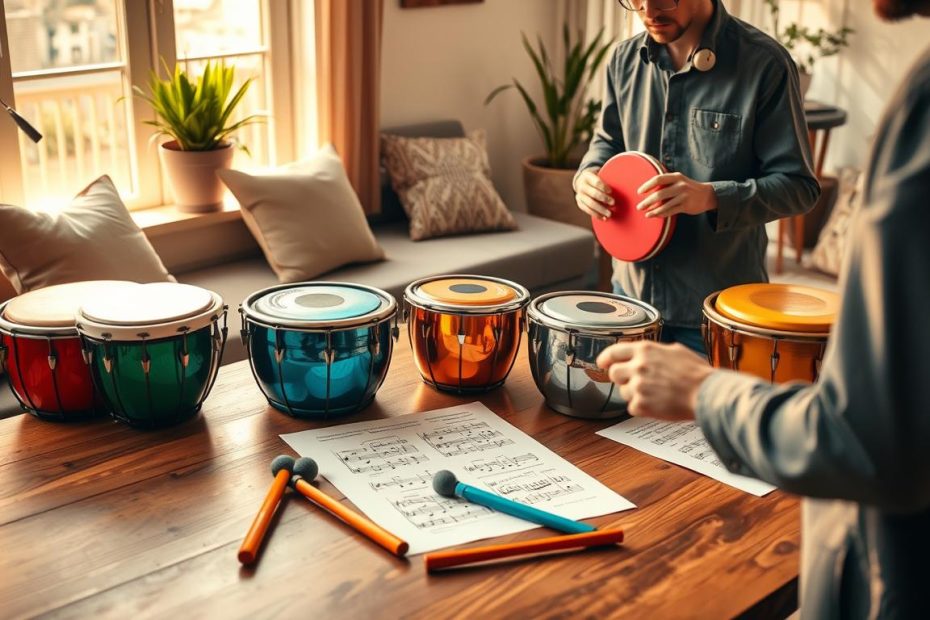
Goal: this guide helps you make the right choice of a melodic percussion instrument. It covers practical criteria: tuning, number of notes, size, materials, and budget.
The number of tongues corresponds to the number of playable notes. Six to ten notes are enough for intuitive playing. Fifteen notes or more give you access to a wider repertoire and arrangements of familiar songs.
As a guide, entry-level prices start around €50, common midrange prices are €200 to €300, and high-end models cost more than €900. Tuning to 440 Hz remains the standard for playing with other instruments; 432 Hz is found on models aimed at wellness.
Size and materials affect projection, resonance, and tuning stability. Choose established brands (Metal Sounds/Zenko, Hluru, HAPI Drum, April Yang) and a seller that offers after-sales support in France, such as Instruments du Monde.
This section outlines what to consider: how you will play, the number of notes, diameter, frequency, scale, quality, and where to buy. Keep your main goal in mind: relaxation, learning, or playing from sheet music.
Quick buying guide for beginners: choose according to how you will use it
Defining how you will use it makes the choice easier. First, consider whether you want to relax, learn gradually, or play from sheet music. Your goal will guide your choice of note count and scale.
Two common approaches: playing from sheet music calls for a diatonic scale and more notes. For intuitive playing, a pentatonic scale or a model with 8 to 10 notes reduces dissonance.
A quick recommendation: 8 to 11 notes for children and 11 to 15 for adult beginners. Look for bundles with mallets, stickers, a booklet, and a carrying case to help you get started.
Also check that the instrument is tuned to 440 Hz if you want to play with other instruments. Listen to demonstrations through headphones and compare tuning accuracy and resonance.
- Clarify your main use and how much room you want to grow.
- Choose a model that goes slightly beyond your immediate needs.
- Check for local after-sales support and sound samples.
| Use | Recommended number of notes | Advantages |
|---|---|---|
| Improvisation / relaxation | 8 to 10 (pentatonic) | Less dissonance, immediate enjoyment |
| Learning and sheet music | 11 to 15 (diatonic) | Wider melodic range and repertoire |
| Children | 8 to 11 | Easy to play, lighter weight |
| Adult beginners | 11 to 15 | Comfort and room to grow |
To narrow your selection, consult a comprehensive comparison and compare user reviews.
Define how you will play this instrument: sheet music or intuitive playing
First, decide whether you want to reproduce written pieces or explore sounds by ear.
Play familiar pieces or create melodies by instinct
Playing from sheet music requires a wide range of notes. Pieces such as The Sound of Silence generally need 15 notes or more. A model with 6 to 8 tongues limits note sequences and requires transposition.
Improvising is often easier with fewer notes. A model with 6 to 10 notes is simpler to learn and reduces the risk of clashing harmonies.

The right number of notes for your level
- Children: 8 to 11 notes — light and accessible.
- Adult beginners: 11 to 15 notes — room to grow.
- Advanced players: 15 notes or more — arrangements and harmonies.
Useful accessories that make learning and playing easier
Simple accessories make learning easier: mallets, stickers, an instruction booklet, and a carrying case. Silicone finger protectors improve comfort if you alternate between fingers and mallets.
| Use | Recommended number of notes | Benefit |
|---|---|---|
| Sheet music (covers) | 15 or more | Fuller repertoire |
| Intuitive playing | 6 to 10 | Simplicity |
| Child / beginner | 8 to 11 | Easy to play |
Practical tip: identify three things you want to do (for example, play two covers and hold one relaxation session) and check that the instrument’s configuration supports them. Listen to demonstrations suited to your goals and consult the Instruments du Monde guide if needed.
Number of tongues = number of notes: which setup is right for a first tongue drum?
The number of tongues determines the instrument’s range of sounds and your musical options.
A simple reminder: each tongue corresponds to one distinct note. An instrument with 11 tongues therefore has 11 notes. This directly affects which pieces you can play and whether you need to transpose them.
Players and uses
- Children / first-time players: 8 to 11 tongues — easy to play intuitively.
- Adult beginners: 11 to 15 tongues — a good balance of versatility and ease of learning.
- Advanced musicians: 15 tongues or more — more options for arrangements and playing from sheet music.
Complexity, models, and their effect on price
More tongues mean a denser layout. Striking them takes greater precision, and accurate tuning becomes essential.
Indicative prices: entry-level models with around 10 tongues often cost less than €100, while a 15-note model costs around €200 or more, depending on the brand. Models with many tongues are less compact and more expensive to make.
“Do not choose a model that is too complex if your goal is meditative improvisation: simplicity encourages creativity.”
To learn more about notes and scales, read everything you need to know about notes.
Size, diameter, and resonance: how dimensions affect the sound
Diameter often shapes the character of the sound: lively on a small model, enveloping on a large one.
Portability — An instrument under 25 to 30 cm is easy to carry in a backpack and generally weighs less than 2 kg. It is well suited to travel and short practice sessions.
Projection and depth — Above 30 cm, the resonating body increases sustain and depth. This size suits calming music and produces a richer resonance.
Closely spaced tongues and interference
On a small-diameter instrument, closely spaced tongues can create unwanted resonances. These can sometimes affect the clarity of the notes.
Depending on your playing style, however, this effect can enrich the harmonic halo. Some players enjoy this livelier character.
| Diameter | Average weight | Recommended use | Sound |
|---|---|---|---|
| < 25 to 30 cm | < 2 kg | Travel, quick patterns | Clear sound, distinct attack, short sustain |
| 30 to 40 cm | 2 to 5 kg | Home, studio | Medium sustain, greater depth |
| > 40 cm | > 5 kg | Calming music, meditation | Very full sound, long sustain, clearer notes |
Practical tip: choose a larger diameter if you want clearer notes and a fuller sound. Always listen to demonstrations through headphones and compare the clarity of each attack. For detailed guidance, consult this size guide: recommended size.
440 Hz or 432 Hz: uses in music, relaxation, and meditation
The tuning frequency affects compatibility with other instruments and the sound. A4 at 440 Hz is the international standard. It makes playing with other instruments and following sheet music easier.
440 Hz: standard tuning, useful for ensemble playing or accompaniment. If you plan to play in a group or follow sheet music, choose this tuning.

432 Hz: wellness uses and practical limits
432 Hz is often chosen for yoga, meditation, and music therapy because some listeners perceive its sound as softer. There is no scientific consensus that it provides a health benefit; it is an aesthetic and sensory choice.
“The difference between 440 Hz and 432 Hz is subtle to the ear; listen to both before buying.”
| Frequency | Advantage | Limitations |
|---|---|---|
| 440 Hz | Compatible with sheet music and ensembles | Standard tuning, widely available |
| 432 Hz | Perceived as softer, suitable for meditation | Models are rarer and more expensive; group playing is harder |
Practical tip: check the tuning stated on the product page. Retuning a handmade instrument involves modifying it and may harm its accuracy. Listen to 440 Hz and 432 Hz versions before deciding.
Scales and keys: major, minor, pentatonic… for playing melodies without clashing notes
The selection of notes defines a piece’s character and affects how easy the instrument is to learn.
Musical moods: the major scale has a bright, balanced character. It works well for simple sheet music and familiar covers.
The minor scale creates a more introspective, melancholy character. It suits relaxation sessions and expressive pieces.
Scales and how they affect learning
Pentatonic: 5 notes per octave. Ideal for improvising without clashing notes and for relaxation.
Diatonic: 7 notes (C, D, E, F, G, A, B). Suitable for common repertoire and reading sheet music.
Chromatic: 12 pitches. Very comprehensive, but it requires a better ear and more practice.
A good starting point and popular alternatives
For a first instrument, choose C, D, or F major. These keys have plenty of accessible tutorials and sheet music.
If you prefer improvising, try D minor or scales such as Amara, Akebono (inspired by Japanese music), or Hijaz (with Middle Eastern sounds).
“Always listen to the exact set of notes: marketing names can be misleading.”
| Type | Number of notes | Recommended use |
|---|---|---|
| Pentatonic | 5 | Improvisation, meditation |
| Diatonic (major) | 7 | Learning, sheet music |
| Chromatic | 12 | Fuller repertoire, demanding playing |
Changing scales with magnets: an interesting but expensive option (around €400 to €500). Often, buying a second instrument dedicated to another scale makes more sense.
Listen to demonstrations and compare models before buying. For more practical information and examples of beginner-friendly scales, consult this resource: guide to scales and tutorials.
Materials and construction: steel, stainless steel, nitrided steel, titanium alloy… what about sound and durability?
An instrument’s material affects both its tone and its lifespan.
How material affects tone, resonance, and tuning
Steel and stainless steel are common materials. They produce a clear, predictable sound.
Nitrided steel improves tuning stability and corrosion resistance. It costs more but stays in tune longer.
Steel-titanium alloy offers a balance of weight, sound, and durability. Decorative finishes can change sustain; pay attention to tuning accuracy.
Durability, care, and everyday use
Simple care: wipe the instrument after each session, keep it away from moisture, and store it in a padded case.
Choose makers that check the tuning before shipping. This reduces returns and helps ensure a good first experience.
- Common materials: steel, stainless steel, copper, nitrided steel.
- Benefit of nitriding: better resistance to impacts and long-term stability.
- Practical tip: if possible, listen to demonstrations of the same model made from different materials.
| Material | Advantage | Disadvantage |
|---|---|---|
| Steel | Affordable, clear sound | Less resistant to corrosion |
| Stainless steel | Durable, requires less care | Slightly higher cost |
| Nitrided steel | Very durable, stable tuning | More expensive |
| Steel-titanium alloy | Good balance of sound, weight, and durability | Limited availability |
“Build quality and tuning checks matter more than material alone.”
Budget and price: how much should you spend on a first tongue drum?
Price often reflects tuning accuracy, durability, and after-sales service. At the entry level, expect to pay around €50 for a small model (6 to 10 notes, around 20 to 25 cm). Versatile instruments with 11 to 15 notes tend to cost around €200 to €300. High-end models often cost more than €700 to €1,000.
Practical recommendation: if you are a beginner, stay below €500. A stable, accurately tuned instrument with 11 to 15 notes may spare you from needing a second one soon.
Design and finishes can raise the price without improving tuning. Always check unedited demonstrations, the return policy, and the availability of after-sales support in France.
- Price guide: around €50 (small model), €200 to €300 (versatile), > €700 (high-end).
- Include accessories (case, supports, mallets) in your total budget.
- Prioritize accurate, stable tuning over appearance.
“Compare recordings through headphones and check after-sales support before buying.”
| Price range | Number of notes | Recommended use |
|---|---|---|
| Around €50 | 6 to 10 | Exploration, portability |
| €200 to €300 | 11 to 15 | Learning and repertoire |
| > €700 | 15 or more | Studio quality, longevity |
Which tongue drum should you choose as a beginner? Brands, sellers, and warranties
Your choice of seller matters as much as the instrument’s configuration. A specialist site can offer advice, tuning checks, and local after-sales support.
Instruments du Monde offers a wide selection, video demonstrations, and tuning checks before shipping. Legal information, a SIRET business registration number, and returns handled in France provide additional reassurance.
A quick look at the brands:
- Metal Sounds / Zenko: careful construction, generous sustain.
- Hluru: affordable prices; check tuning accuracy.
- HAPI Drum: gentle sound, suitable for learning.
- April Yang: thoughtful design, a useful range for covers.
New or used: choose new if you want a warranty and the option to return the instrument. If buying used, ask for a video of the instrument, test every note with a tuner, and check for corrosion.
Take care with marketplaces: quality and tuning vary. Look for traceability and verified customer reviews. Contact the seller to confirm the tuning (440 or 432 Hz), scale, and complete note list.
| Option | Benefit | Risk |
|---|---|---|
| Specialist site | Advice, quality checks, after-sales support in France | Possible delays for high-end models |
| Used | Lower price | No right of withdrawal; careful checks are essential |
| Marketplace | Wide selection | Variable tuning, uncertain after-sales support |
Consult a comparison if you are deciding between several models or scales.
“Starting with a specialist reduces unpleasant surprises and helps you choose an instrument that suits your goals.”
Conclusion
To make the best choice, consider tuning, the number of notes, size, and budget. First, define how you will use the instrument: sheet music or improvisation, performance or relaxation. This will help you choose the right number of notes and diameter.
Tuning: choose 440 Hz if you play with other instruments; 432 Hz is an aesthetic choice for wellness, with practical limitations.
Focus on tuning accuracy, resonance, and build quality. Listen to demonstrations through headphones and check the product specifications (frequency, scale, note list) before buying.
To buy with confidence in France, choose a specialist site that offers after-sales support. You can also consult the guide here: practical guide.
In short, this article gives you a method for making an informed, lasting choice. Match the instrument to your goals, and plan for a carrying case and regular care to keep it in good condition.