
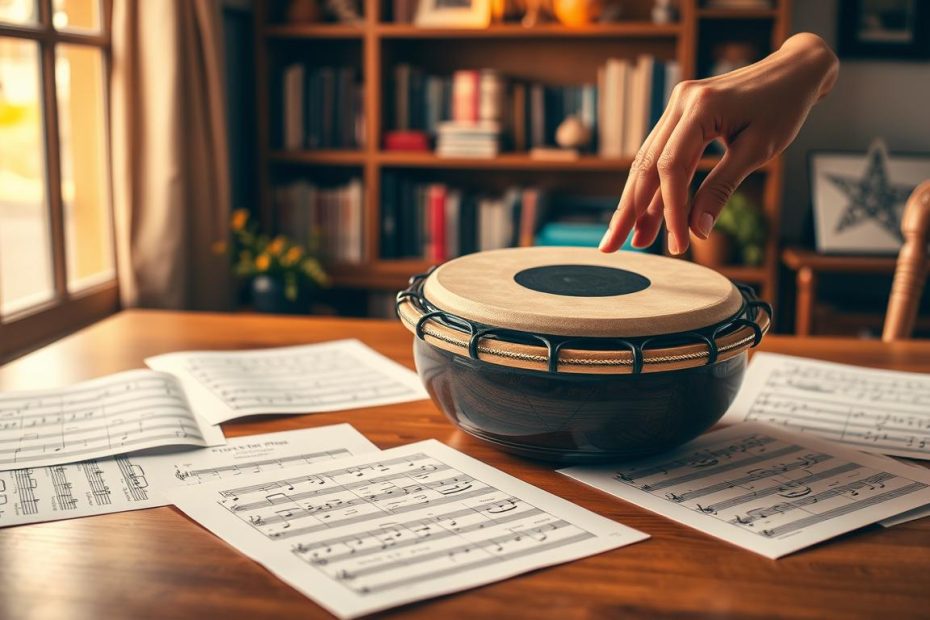
Discover a clear guide to finding and using steel tongue drum sheet music. This article presents an online resource center organized by skill level and style. The aim is to save time and better organize your daily music practice.
The method is simple: numbered notation (1 = C, 2 = D), octave marks (1°/1.), and chords (13) make learning easier. We present usable examples, such as Happy Birthday (sequence 1-1-2-1-4-3), played at around 80 BPM.
You will find printable PDFs that you can annotate, tutorials, and the ZenaPan booklet with 13 tunes for beginners. Sites such as Instruments du Monde, TongueDrumTunes.com, and DrumSheetMusic.org organize songs by difficulty and tempo.
This guide supports your progress, from discovering the instrument to creating your own melodic lines. Studies cited by Emmanuel Bigand and the CNRS confirm that reading sheet music stimulates visual memory and confidence.
The tongue drum sheet music resource center: purpose, audience, and immediate benefits
This center brings together the best resources to help you learn the instrument faster. It offers a clear learning path, tested methods, and visual aids that reduce study time.
Who it is for: beginners, self-taught musicians, and experienced players. Everyone can find a path suited to their level and make progress without wasting time.
The immediate benefits are tangible: faster learning, intuitive reading of numbers, and more fluid playing thanks to visual cues and PDFs you can annotate.
According to some accounts, the ZenaPan method and numbered notation can reduce learning time by about 40%. Reading stimulates visual memory (CNRS) and improves hand-eye coordination.
- Melodies suited to 9- to 15-note models, with numbered stickers.
- Step-by-step tutorials, transposable resources, and practice plans to reach the next level.
- Organization by theme and difficulty for a relaxed learning experience.
This center also offers advice on planning sessions, choosing songs, and tracking your progress. Good tools encourage more confident playing and measurable results.
To expand your library, explore our kalimba resources: they complement this guide and enrich your melodic lines.
Understanding numbered notation and essential symbols for beginners
A clear numbered system makes complex sheet music immediately readable for beginners. The basics: 1 = C, 2 = D, 3 = E. This correspondence helps you recognize notes on your instrument more quickly.
Notes, octaves, and chords
Octaves are marked with a dot: 1° for the higher octave and 1. for the lower one. This prevents confusion between registers and ensures accuracy when playing.
Chords are written in parentheses, for example 13 for C + E. They indicate notes struck together to enrich the harmony.
Rhythm, duration, and rests
The rhythmic symbols are simple: dashes extend a note’s duration, vertical bars separate measures, and a dot adds half the note’s value. Rests are often shown as 0 or a space.
Converting to letter names and practicing
In letter notation, C = Do, D = Re, and E = Mi. Software such as MuseScore makes it easier to convert between numbers and letters and to transpose music to suit a scale.
“Start slowly with a metronome set to 120 BPM to steady the tempo and understand note lengths.”
A short practical example: Frère Jacques begins with 1-2-3-1. For more on conversion and reading, see our practical guide to numbered notation.
Easy Tongue Drum Sheet Music PDFs to Download
Here are three packs tested for beginners, designed to help you get started quickly and progress gradually.
Recommended packs for beginners
Débutance (Instruments du Monde) offers 15 folk melodies with diagrams showing which notes to strike. Suggested tempos: 60 to 80 BPM. Average song length: 1 to 2 minutes.
ZenFlow (TongueDrumTunes) focuses on meditative exercises. It includes a visual metronome. Recommended tempos: 40 to 60 BPM.
ClassicPro offers simplified classical arrangements. Suggested tempos: 70 to 90 BPM. Ideal for developing musicality.
Quality criteria and practical advice
Check that the music matches your instrument’s scale (6, 9, 11, or 15 notes) so you avoid notes outside its range and can play smoothly.
Look for teaching aids: diagrams, a metronome, and phrasing tips. PDF format lets you print and annotate the sheet music to track your progress.
Start with two slow songs (60 to 70 BPM), then increase the difficulty. To learn to read music, see our guide on how to read sheet music and visit specialist sites for more sheet music and resources.
Simple melodies you can play today: Happy Birthday, Frère Jacques, and Au clair de la lune
Start today with three simple tunes that establish the basics of playing and rhythm.
Happy Birthday — sequence: 1-1-2-1-4-3. Suggested tempo: about 80 BPM. Suitable for models with 9 notes or more.
Frère Jacques — sequence: 1-2-3-1 / 1-2-3-1 / 3-4-5 / 3-4-5. Tempo: about 90 BPM. You can play it as a round; alternate hands to divide up the phrases.
Au clair de la lune — in 2/4: 1-1-1-2 / 3-3-2-1. Tempo: about 70 BPM. Tap the beat with your foot to keep the tempo steady.
- Count the beats quietly and tap your foot lightly to establish the tempo.
- Progression: start slowly, focus on playing each note clearly, then raise the tempo by 5 BPM per session.
- Expressive variation: hold a note, add a little rubato, or insert a short rest.
- Practical exercise: play each pattern three times, then combine them to develop muscle memory.
Self-assessment goals: steady tempo, accurate intervals, comfortable hands, and consistent tone.
These simple melodies provide a solid foundation. To develop your reading skills, see how to read sheet music.
Where to find reliable, free sheet music PDFs
If you are looking for reliable, free resources, these French-language and international platforms are a good starting point.
Recommended specialist sites
Instruments du Monde — an extensive French-language catalog with practical guides and downloadable files.
TongueDrumTunes.com — filters by genre and level, useful for sorting songs by tempo and difficulty.
DrumSheetMusic.org — more complex rhythmic scores, audio tracks, and playing examples.
| Platform | Strengths | Best for |
|---|---|---|
| Instruments du Monde | French-language guides, clear reference sheets | Beginners and teachers |
| TongueDrumTunes.com | Filters by style and difficulty | Quickly sorting melodies |
| DrumSheetMusic.org | Audio tracks, advanced rhythms | Musicians looking for a challenge |
Communities and methods
Join the “TongueDrumFR” Reddit community, specialist Facebook groups, and YouTube channels to watch tutorials and request arrangements.
Practical tip: check the original key and transpose songs for 9-, 11-, or 15-note models. Use Notepan to create versions suited to your scale.
Try three songs within 48 hours: practice with a metronome and keep the ones on which you make measurable progress.
Finally, to expand your search for free sheet music, explore our selection of free tongue drum sheets and compare the scores with video tutorials to support your learning.
Read sheet music faster: methods, tools, and mistakes to avoid
To play your songs more smoothly, combine short sessions, active listening, and regular breaks.
The 20/5/30 method: play actively for 20 minutes, listen or review the music mentally for 5 minutes, then take a 30-second break. This cycle supports memory and confidence.
Practicing with a metronome
Use a metronome (such as the Korg MA-2 or an app) to steady the tempo. Start between 60 and 80 BPM, then increase it in 5 BPM steps as your accuracy improves.
Common pitfalls and how to correct them
Common mistakes involve rests, reading octaves, and confusing note durations. Isolate the troublesome measure, read it aloud, then clap its rhythm before playing.
Checking your progress: record one take a day, compare how steadily you play, and note one exercise to focus on. Keep your phrasing simple and raise the difficulty gradually.
| Element | Action | Goal |
|---|---|---|
| 20/5/30 method | Short cycles and a break | Memory and concentration |
| Metronome | Increase in 5 BPM steps | Rhythmic stability |
| Focused exercises | Read aloud and clap rhythms | Accurate note lengths |
“Regular practice and focused exercises make reading faster and more expressive.”
Practical tips for progress: routine, accuracy, and musicality
A simple, structured four-week plan can develop your daily practice. This guide offers a practical program for improving accuracy and musicality without overloading your schedule.
30-day program
Week 1: spend 15 minutes a day on the C major and A minor scales to build a solid foundation.
Week 2: practice rhythmic combinations and variations at 60 to 80 BPM; use a metronome to maintain a steady tempo.
Week 3: begin improvising over simple chords; use a limited set of patterns to develop your ear.
- Structure your routine: warm up, play scales, practice transitions, then apply them to melodies.
- Add accuracy exercises: controlled strikes, consistent volume, and relaxed wrists.
- Suggested duration: 15 to 25 minutes per session; review your progress each week to assess your level.
- Record your sessions (Zoom H1n) and use Pro Metronome or Soundbrenner: these tools can speed up progress by about 40%.
“Consistency matters more than duration: short, frequent sessions help you build lasting skills.”
Tips: connect each goal to a melody you want to learn to keep yourself motivated. Regular practice combined with focused exercises makes learning more effective and playing more enjoyable.
Equipment and playing comfort: fingers, mallets, and protection
Taking care of your equipment makes every session more comfortable and musical.
With this instrument, choosing between fingers and mallets affects the tone, volume, and length of your sessions.
Finger protection: nylon, leather, or cotton guards reduce impacts and help prevent pain. They make longer, more regular sessions more comfortable.
- Silicone mallets: durable, around €45 per year; a rounder sound.
- Wooden mallets: around €25 per year; a brighter, more natural attack.
- Assess the head, flexibility, and grip according to the kind of strike you want.
Warm-up: move your fingers, stretch gently, then make a few controlled strikes on each note. Use a stress ball and keep your hands hydrated.
“Butterfly” method: alternate your left and right hands to steady the rhythm, reduce fatigue, and even out the sound.
“Short, regular breaks help preserve accuracy and hand health.”
Check these points for comfort: upright posture, suitable playing height, hand position, and visual cues. A digital metronome helps you keep the tempo, whether moderate or brisk.
Create or adapt your own sheet music: software, transposition, and hybrid systems
Adapting a familiar melody sometimes takes only a few changes to make it playable on your instrument. This guide presents tools and a method for converting, testing, and sharing your arrangements.
Free tools and a working method
MuseScore 4 offers an intuitive interface, clear notation, and PDF export. Automatic transposition makes adaptation easier (for example, moving a piece down 5 semitones).
Notepan offers templates for smaller scales (6, 9, 11, or 15 notes) and a ready-to-use layout.
Transposition and practical adaptation
Identify the original key, transpose by semitones, and check the intervals against your scale.
For notes outside the instrument’s range, replace them with the nearest available note, change octaves, or simplify the chord (for example, 1-3-5 becomes 1-3).
Hybrid systems and reading accuracy
Combine traditional sheet music with visual tablature to make reading easier and improve rhythmic accuracy.
- Enter the notes as numbers, test them with a metronome, then export the finished score.
- Align rhythmic symbols carefully so the music is reliable to read.
- Follow MuseScore and Notepan tutorials to avoid layout mistakes.
Mini-project: adapt a popular melody with both kinds of notation, test it with a metronome, and adjust the number of notes before publishing the PDF.
Final tip: to find suitable sheet music, share your versions and gather feedback to improve the quality and accuracy of your learning.
Conclusion
A good guide, reliable resources, and a few tools are enough to expand your musical range. Understanding the symbols and numbered system, choosing quality sheet music, and practicing regularly are the key steps toward progress.
The benefits are tangible: faster reading, more accurate notes and durations, and greater confidence in keeping time.
To go further, try new melodies, adapt songs, and share your versions with communities. Also explore our 6-note sheet music pack to expand your library.
By combining good resources, tools such as MuseScore and Notepan, and a short, regular routine, learning becomes natural and rewarding. Whether your goal is simple or ambitious, the quality of your sheet music and method makes all the difference to your skills and enjoyment of playing.