
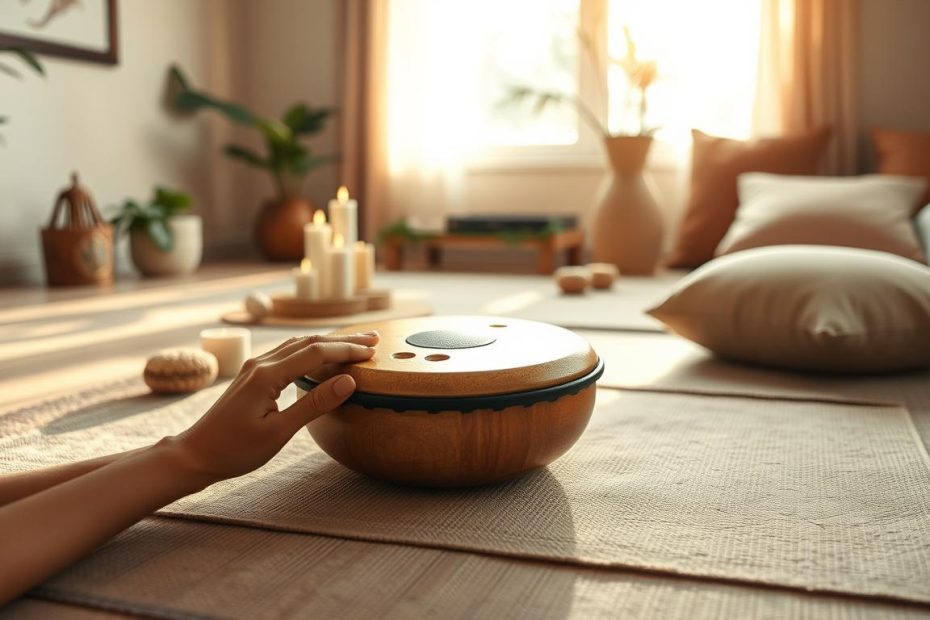
This guide presents the tongue drum as an accessible instrument for encouraging relaxation and mindfulness. It explains how to build a simple, lasting practice step by step.
Contemplative music differs from distracted listening: it invites attention, breathing and visualization. This article draws on research and established methods to guide beginners and experienced players alike.
Potential benefits: less stress, a calmer mind, better sleep and improved concentration through intuitive drumming.
Here you will learn how the instrument works, how to prepare your space and body, how to choose suitable rhythms and how to make this practice part of everyday life, even when time is short.
To explore a ready-to-play model and get started easily, see this recommended instrument.
Why the tongue drum is a useful relaxation tool today
The soothing sounds of a slit-tongue instrument help many people ease into meditation. Its clear tones and simple playing technique make it possible to reach a state of calm quickly, without prior musical training.
Studies suggest tangible effects: lower stress, better sleep quality and less anxiety. A study published in PLOS One in 2013 notes that low frequencies lower cortisol, while a study published in Acta Medica Lituanica in 2018 observes stimulation of alpha and theta waves.
In practical terms, this tool produces steady vibrations and enveloping sounds that bring body and mind into harmony. Slow rhythms encourage muscles to relax; livelier tempos strengthen concentration.
- Accessibility: a lightweight, ready-to-play instrument that needs little maintenance.
- Benefits: measurable stress reduction and support for sleep.
- Emotional comfort: gentle, unobtrusive sounds suited to meditation.
To explore the instrument’s technical features and advantages, read about the benefits of an instrument tuned to 432 Hz.
Understanding the instrument: tongue drum sounds and playing principles
To understand the instrument, it helps to look at its origins and the simple mechanism behind its tones.
Origins, materials and tongues
The modern design draws on ancient slit drums and newer instruments such as the handpan.
It is made by cutting metal tongues. The larger the tongue, the lower the note.
Most models use steel or alloys. These materials provide clear resonance and require little maintenance.
The volume is often around 70 to 80 dB, allowing you to play at home without causing a disturbance.
Notes, scales and pentatonic resonance
The pentatonic scale has five notes and encourages intuitive improvisation: the notes sound harmonious in any order.
On a diatonic instrument with seven notes, you can simulate a pentatonic scale by avoiding the F and B tongues in positions 4 and 7.
- Accessibility: beginners can start playing right away.
- Stability: durable tuning that needs fewer adjustments than a hammered handpan.
For care tips that can help extend your instrument’s life, read this article on maintenance.
Preparing your space and mind for a soothing practice
Setting up your space before playing has a strong influence on the quality of a session. A simple environment helps your body let go and makes it easier to concentrate.
Comfort, calm and concentration: create a sound sanctuary
The three C’s: comfort from a mat or cushion, calm from limiting distractions, and concentration supported, if you wish, by a gentle metronome.
Adjust the lighting and temperature, then reduce background noise. Rugs and curtains can improve how the sound is perceived.
Body position and instrument placement for feeling vibrations
Choose a position that creates no strain: cross-legged, on a chair or lying down, according to what suits your body. Your posture should remain comfortable throughout the session.
- On your lap: direct perception of the vibrations.
- Between your legs: a stable position when sitting cross-legged.
- On a surface with pads: better sound projection when you sit on a chair.
| Placement | Advantage | Best for |
|---|---|---|
| Lap | Strong tactile transmission | Personal sessions and low notes |
| Between the legs | Good stability | Playing while seated on the floor |
| Stable surface | Improved sound projection | Playing from a chair or at a table |
Begin with a few cycles of slow breathing to bring your attention back to the present. Think of the instrument as a grounding tool: it offers sensory points of focus for body and mind.
Breathing, concentration and visualization: techniques that support meditation
Synchronizing your breathing with each strike turns playing into a meditative practice. It helps steady your concentration and sustain a mindful state.
Deep breathing and the 4-7-8 method
Lengthen your exhale, relax your shoulders and let your breath guide your hands. Inhale for four counts, hold your breath for seven counts, then exhale over eight even strikes to help regulate your nervous system.
This simple method anchors your attention in your body and the sounds.
A focal note, mantras and visualization
Choose a reference note and return to it without judgment whenever your mind wanders. Short mantras chanted to the rhythm of the drum can strengthen concentration.
Pair images such as light, a path or waves with the sound waves to enrich the sensory experience.
“Simple, rhythmic repetition reduces cognitive overload and makes it easier to enter meditation.”
| Method | Recommended duration | Main effect |
|---|---|---|
| Synchronized 4-7-8 breathing | 2 to 3 minutes per cycle | Physical calm and stress regulation |
| Focusing on one note | Short, repeated sessions | Improved concentration |
| Rhythmic mantra and visualization | 2 to 4 minutes | Deeper meditation and guided imagery |
Structure your session in short cycles that alternate guided breathing and minimal playing. Always finish with a few seconds of silence to notice the lingering resonance and settle into calm.
Slow or fast rhythms: choosing according to your intention
The rhythm you play can shape your mental state from the first few strikes. Research from the University of Nevada suggests that a fast tempo improves concentration and optimism, while a slow tempo encourages muscle relaxation.
BPM guidelines: < 60 BPM to reduce stress, 60 to 80 BPM for steady attention, and > 90 BPM to stimulate creativity.
- Clarify your intention: settle your mind at the end of the day or energize yourself before a task.
- Play fewer strikes to calm yourself; increase them slightly to engage your attention.
- Start with short sessions of 10 to 15 minutes and note their effects.
“A suitable rhythm guides breathing and shapes brain activity during meditation.”
| Goal | Tempo (BPM) | Expected effect |
|---|---|---|
| Calm | < 60 | Relaxation and reduced stress |
| Steady attention | 60 to 80 | Stable alertness |
| Creative energy | > 90 | Concentration and energy |
Try different tuning frequencies according to your preferences. For practical advice, discover how to play the tongue drum without being a musician.
Tongue drum and relaxation: create a calming routine step by step
Establishing a simple routine you can repeat turns playing into a genuine daily practice. Start with a short, 10-minute session: two minutes of breathing, five minutes of simple pentatonic patterns, then two to three minutes focusing on a central note.
Choose a regular time. Morning sessions can clear your mind; evening sessions can help release the day’s tension. Consistency matters more than duration.
On a diatonic instrument, avoid tongues 4 and 7, F and B, to stay within a pentatonic scale without dissonance.
Practical method: divide the session into 60 to 90 seconds of playing followed by 30 seconds of listening and silence. Repeat the pattern to strengthen your sense of presence.
Try this exercise: your left hand plays a slow pulse while your right hand picks out three recurring notes. Finish by returning to your breath and forming a brief intention of gratitude.
- Record your experience: note how you feel, how calm you are and how easily you can concentrate.
- Repeat the techniques: use a mantra over two or three notes and return to your breathing when your attention drifts.
To get started quickly with this instrument, explore this recommended model.
“Short daily sessions support a lasting practice and produce clearer results than an occasional long session.”
Choosing the right tongue drum for peaceful meditation
Your choice of instrument directly affects the quality of your sound sessions. These practical criteria can help you find a model suited to meditation.
Number of notes, diameter and build quality
Number of notes: choose 6 to 11 notes for a good balance of simplicity and variety.
Diameter: a diameter of at least 30 cm produces deeper low notes and vibrations you can feel more readily in your body.
Quality: look for well-tuned steel, precisely cut tongues and even resonance.
Pentatonic or diatonic scale and tuning frequencies
A pentatonic scale makes intuitive improvisation easier. A diatonic scale offers more possibilities but requires you to avoid certain notes.
As for frequency, some listeners perceive 432 Hz tuning as gentler; 440 Hz remains the standard for playing with other instruments.
Adapting a diatonic instrument for meditation
If you have a diatonic model, avoid tongues 4, F, and 7, B, to create a stable pentatonic scale.
Test how it feels to play: look for a gentle attack, a rounded tone and sounds that do not feel harsh to your ears.
- Compare models: portable and larger models meet different needs for mobility and depth of sound.
- Check the accessories: consider the case, mallets and the reputation of makers such as Zenko and Idiopan.
For similar instruments and buying advice, see these models and tips.
Accessories and practical ways to improve
Progress depends on your equipment as well as your movements.
Mallets, a case, a metronome and useful apps
Mallets: choose silicone or leather heads to vary the feel. Soft heads produce gentle sounds; playing with your fingers gives you more direct contact.
Protection: a padded case protects the instrument during transport, especially if you practice yoga or play in different places.
Metronome and apps: set the tempo between 40 and 60 BPM to establish slow patterns. Use a tuning app to check the stability of the notes over time.
Guided exercises and simple patterns
Short exercise: play freely for three minutes each day, then spend two minutes on exercises using two or three notes. This format makes daily practice easier to maintain.
- Alternate your right and left hands to develop coordination.
- Synchronize your breathing and strikes: inhale for four counts, then strike gently as you exhale.
- “Playing the tongue drum” exercise: your left hand plays a low note while your right hand picks out two high notes.
Care: avoid moisture, clean the instrument with a soft cloth and store it in its case.
“Small rituals and the right tools make steady progress enjoyable.”
Bringing the tongue drum into daily life and wellness practices
A few minutes of playing can have a positive effect on your day.
Short morning and evening sessions and a progress journal
Morning: seven minutes of free playing to synchronize your breathing and refresh your mind.
Midday: a four-minute break centered on one note to refocus your body and mind.
Evening: 10 minutes of light strikes to help you settle for sleep and calm your mind.
- Plan short sessions of 5 to 10 minutes to make your practice more consistent.
- Keep a journal of the duration, your favorite notes, your emotional state and any benefits you notice.
Combining the instrument with yoga, qi gong and musical meditation
Pair the drum with yoga nidra, favoring low notes. Synchronize movement and sound during a qi gong session to strengthen the connection between body and mind.
Musical practice offers an auditory anchor and helps many people engage in active meditation.
| Time | Duration | Goal |
|---|---|---|
| Morning | 7 min | Wakefulness and synchronized breathing |
| Midday | 4 min | Recentering and a mental break |
| Evening | 10 min | Preparing for sleep and calming the mind |
To learn more about 432 Hz tuning and its effects, read this article on the benefits of 432 Hz.
Conclusion
In short, clear tones and vibrations offer an accessible path to calm.
This guide shows how simple the practice can be: breathing, focusing on one note, short mantras and easy patterns played in brief cycles. These actions support meditation, concentration and a reduction in stress.
Choosing a well-tuned instrument with 6 to 11 notes and a suitable diameter, then practicing briefly each day, can strengthen the benefits for sleep and mental well-being.
Adapt the method to your experience, keep a journal and try different scales and models. Let the instrument become a tangible anchor that connects body and mind over time.