
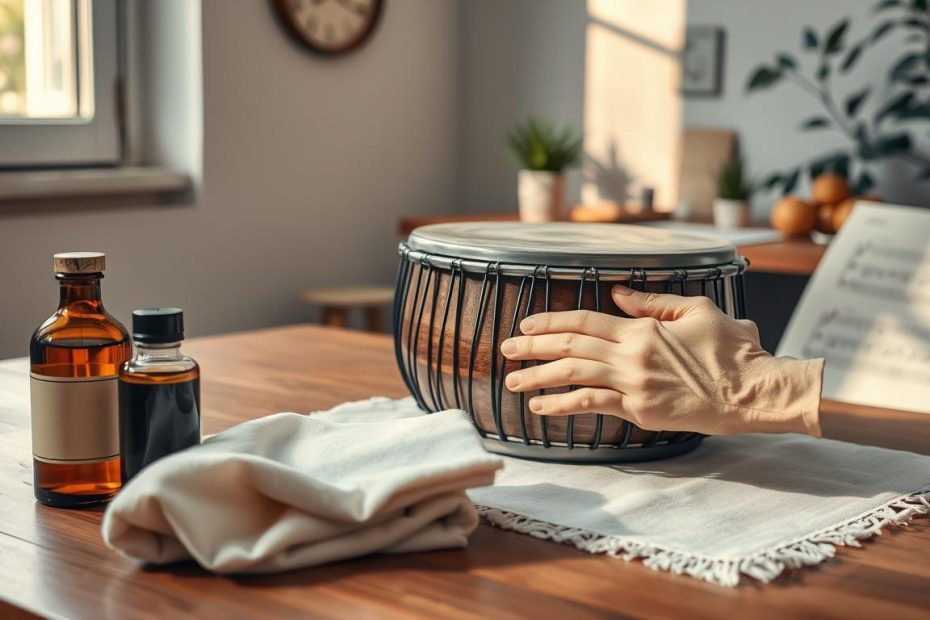
What you’ll learn: this article shows how to preserve your instrument’s sound quality and lifespan with simple steps and safe products.
Unsuitable humidity causes 70% of acoustic problems. Without regular care, a drum can lose up to 30% of its resonance in six months.
Simple tools are enough: a microfiber cloth absorbs 75% more dirt than a cotton cloth, soft brushes clean the grooves, and suitable oiling can increase lifespan by up to 70%.
We’ll cover cleaning, protection from moisture, tuning, storage, wooden and steel models, and choosing a suitable case. For more on wood, see this practical guide: wooden tongue drum care guide.
Benefit: investing in maintenance avoids costly repairs (around €150 for steel) and preserves playing quality every day.
Why regular maintenance improves your instrument’s sound quality and lifespan
You can hear the difference. A well-maintained drum produces clearer harmonics, steadier notes, and a better dynamic response. Without simple care, resonance can drop by around 30% in six months.
Measurable benefits for resonance and tuning accuracy
Dust and marks weigh down the surface. They interfere with frequencies and note attack. Monthly cleaning restores clarity and harmonic balance.
Lower costs and a longer lifespan
A few euros’ worth of products and a few minutes each month can prevent costly repairs: restoring a steel model costs €150 on average. Regular oiling can increase its useful life by up to 70%.
- Freer vibrations produce better harmonics.
- Gentle, regular care limits microcracks.
- Keep a log or photos: warranties often require proof of maintenance.
Start with simple routines, then set an annual schedule. To learn more, see this 432 Hz tongue drum guide for instrument care advice.
How to maintain and protect your tongue drum: the basics
An invisible film of dust changes how your notes carry through a room. Particles and fingerprints affect the vibrating surface and reduce harmonic projection.
How dust, humidity, and marks affect the instrument
Keep humidity stable between 40% and 60% to avoid oxidation and warping. Temperature changes accelerate material aging.
The seven pillars of an effective routine
To take good care of your drum, follow these simple practices:
- Monitor humidity.
- Clean the surface with a soft microfiber cloth after each session.
- Clean the grooves with a soft brush.
- Dry the instrument completely before putting it away.
- Apply an oil suited to the material (ask the maker about wood).
- Protect it from impacts.
- Store it in a case or dust cover.
Quick habits: keep your hands clean and dry, avoid very damp rooms, and place a visual reminder near where you play. A little regular cleaning is better than trying to catch up later.
Tools and products for safe maintenance
Choosing the right tools prevents accidents and preserves note clarity. Suitable equipment limits wear and makes regular care easier.
Useful cloths, brushes, and accessories
Choose a soft, lint-free microfiber cloth: it absorbs 75% more dirt than a cotton cloth and does not damage the surface.
For narrow spaces, use an interdental brush or a fine-bristled toothbrush. An air blower removes dry dust without contact.
Consider wearing cotton gloves when handling the instrument and using a case with foam lining to protect it from impacts.
Protective oils and rust-prevention products
For metal, Ballistol (94% effectiveness) and WD‑40 Specialist (resistant to salt water) are recommended.
Apply a very thin, even coat and wipe away the excess: too much oil weighs down the instrument’s vibrations.
Add silica gel (up to 40% absorption) or a humidity-control case to limit moisture.
What to avoid
“Never use ammonia, petrochemical solvents, or abrasives on the surfaces or tongues.”
These products cause electrochemical reactions and damage finishes.
Before using any new product, test it discreetly on a hidden area, especially on wooden models.
- Choose tongue drum care products according to the material: for wood, use the oil recommended by the maker; for steel, use a water-repellent barrier.
- Choose a rigid or semi-rigid case with foam if you travel frequently.
Step-by-step cleaning after each use and for a deeper clean
After every session, one simple step immediately preserves note clarity.
A quick routine after each playing session
Wipe the surface with a soft, dry cloth to remove dust and fingerprints.
Do this consistently after every use to keep the harmonics clear.
A deep-cleaning method
Once a week, clean the instrument thoroughly (allow about 40 minutes).
Barely dampen a cloth with mildly soapy water, then wipe the shell.
Next, use a soft brush in the grooves and around the tongues.
Rinse the cloth, wipe without rubbing too hard, and remove all the suds.
Drying, polishing, and oiling
Wipe immediately with a clean, dry cloth. Let the instrument air out for a few minutes before putting it away.
For the oil, apply a very thin film in circular motions, then remove the excess. Too much oil muffles vibrations.
- Adapt care to wood: use only gentle products, dry it completely, and follow the maker’s oiling recommendations.
- Safe products: silica gel for storage and compatible oils; avoid ammonia and solvents.
- Practical checklist: dry cloth, microfiber cloth, soft brush, oil, clean cover — keep everything within reach.
Track the time you spend on maintenance and record the date of the last deep clean. These simple steps help keep the notes stable and your drums’ sound quality consistent.
Protecting your tongue drum from moisture and rust
Keeping humidity stable around the instrument significantly extends its life. Target humidity level: 40% to 60%; above 70%, oxidation accelerates and rust spots appear.
Humidity, temperature changes, and risks
Temperature changes cause metal to expand. The tongues may warp and the tuning may drift.
Warning signs include oxidation spots, a muffled sound, and notes that drift out of tune.
Applying oil and choosing products
Method: apply an extremely thin coat, wipe away the excess, and repeat more often in humid conditions.
Recommended products for steel: Ballistol and WD‑40 Specialist (water resistant). Too much oil harms vibration quality.
Silica gel, humidity-control cases, and storage
Silica gel (up to 40% absorption) and a humidity-control case (around €55) help stabilize humidity during transport.
Practical tips: air out the instrument after playing, wipe off condensation, and avoid sudden temperature changes. For a small touring kit, bring silica gel packets, a microfiber cloth, and a small bottle of oil.
“Good protection reduces the need for major repairs and preserves sound quality.”
| Action | Purpose | Recommended product |
|---|---|---|
| Humidity monitoring | Prevent corrosion | Hygrometer and humidity-control case (around €55) |
| Rust-prevention barrier | Protect the steel surface | Ballistol, WD‑40 Specialist |
| Moisture absorption | Reduce residual humidity | Silica gel (up to 40%) |
| Small kit | Protect the instrument while traveling | Silica gel packets, microfiber cloth, light oil |
For detailed advice on caring for this instrument, see this practical guide: specialist care guide.
Preventing impacts, scratches, and microcracks every day
An unsuitable support increases minor impacts and can affect your drum’s tuning. Use vibration-absorbing supports to keep the instrument in good condition.
Recommended surfaces and supports
Choose cork at least 5 mm thick or an EVA foam mat (density 45 kg/m³). These materials limit unwanted impacts.
Avoid hard surfaces such as marble or bare metal: they encourage scratches and microcracks. Never put heavy objects on the drum.
Covers, hard cases, and foam: which suits your needs?
For use at home, a padded cover is enough. If you travel often, choose a polycarbonate hard case (resistant to drops of up to 1.5 m) with reinforced corners.
Memory foam (IP67 certified) protects the structure and dampens vibrations, improving the playing experience and musical consistency.
- Short trips: padded cover.
- Travel or crowds: hard case with a secure closure.
- For wooden models, avoid very tight straps that leave marks.
Check the instrument before and after every trip: this simple routine can prevent many repairs.
To choose a good case, see our recommended case.
Tuning and periodic maintenance for lasting accuracy
Accurate tuning maintains the instrument’s harmonic balance over time. It preserves sound quality and makes music sessions more reliable.
Checking note accuracy and detecting deviations
Use a spectrum-analysis app (such as TuneLab) to measure each note. It detects small deviations and displays the drift in cents.
Warning threshold: a variation greater than ± 5 cents indicates that an adjustment is needed.
When to call a professional
Call a technician if notes are too low, sound hollow, or have unstable harmonics after correction.
Some models require specific expertise: avoid uncertain adjustments that could damage the tongues.
“Choose gentle, spaced-out corrections over repeated blows.”
How often to check, depending on use
Practical guidelines:
- Occasional use: check every three months.
- Regular use: check monthly.
- Professional use: check weekly.
For fine adjustments, use a magnetic tuning hammer (around €49.95): it lets you adjust notes without marking the surface.
Record the frequency and dates of adjustments in a log. Your ear complements the tool: play, listen, then adjust.
For detailed methods and recommended tools, see this practical guide: tuning methods and tips.
Care requirements for wooden and steel models
Care varies by material: wood needs gentle treatment, while steel needs protection against corrosion.
Caring for wooden models
For a wooden drum, avoid excess water. Use a gentle product and a microfiber cloth. Dry it completely after cleaning.
Tip: ask the maker which oil suits the wood species. Apply it in a thin, even coat.
Preventing oxidation on metal models
For a steel drum, apply a very thin coat of Ballistol or WD‑40 Specialist. Clean with a barely damp cloth and a soft brush near the tongues.
Always remove excess oil so it does not weigh down the vibrations. Renew the protective oil coat periodically.
“Appropriate care helps notes stay stable and project clearly.”
| Material | Key action | Recommended product |
|---|---|---|
| Wood | Gentle cleaning, complete drying, oil recommended by the maker | Oil supplied by the maker |
| Steel | Gentle cleaning, soft brush, very thin coat of oil | Ballistol, WD‑40 Specialist |
| General | Microfiber cloth, light handling, record of products used | Microfiber cloth, maintenance log |
Use a method suited to each model: it extends the instrument’s life and maintains note quality.
For a practical account, read this review and firsthand experience.
Safe storage and transport to preserve condition and quality
A suitable storage space greatly reduces mechanical wear and climate-related damage. Aim for a temperature of 18 to 22 °C and limit changes to 2 °C per day. Keep humidity between 40% and 60% to stabilize the material and tuning.
Monitor these conditions continuously with a Bluetooth sensor such as the HygroLog HL1E (around €89). It warns of changes and helps preserve the instrument’s quality for years.
Choose a case according to use: a padded cover for short journeys; a multilayer hard case for frequent travel. Look for a polycarbonate shell, memory foam, reinforced corners, and accessory pockets.
When traveling, secure the instrument so it cannot move, add silica gel packets to stabilize humidity, and use a reflective cover if sun exposure is unavoidable. In a car, limit vibrations and immobilize the instrument. On a train, avoid crowded luggage racks. On a plane, choose the cabin if possible.
Practical tip: record the date of the last impact and inspect the instrument after every trip. A good case and a few simple habits extend its useful life and preserve the drum’s quality.
Conclusion
In practice, a few minutes each week improve your drum’s condition and extend its life.
Quick recap: gentle cleaning, humidity checks, impact protection, rust prevention, regular tuning checks, suitable storage, and consistent care. These habits preserve note stability and musical quality.
The benefits are tangible: fewer repairs, more years of use, and a better sound. A simple schedule lets you combine playing and maintenance without wasting time.
For wooden models, follow the maker’s recommendations. Consult a professional for tuning if needed. Investing in a good case extends this instrument’s life.
Keep a checklist, record maintenance, and judge progress by listening and by how the instrument feels to play. That way, this article becomes a practical guide to keeping your drums ready to play year after year.