
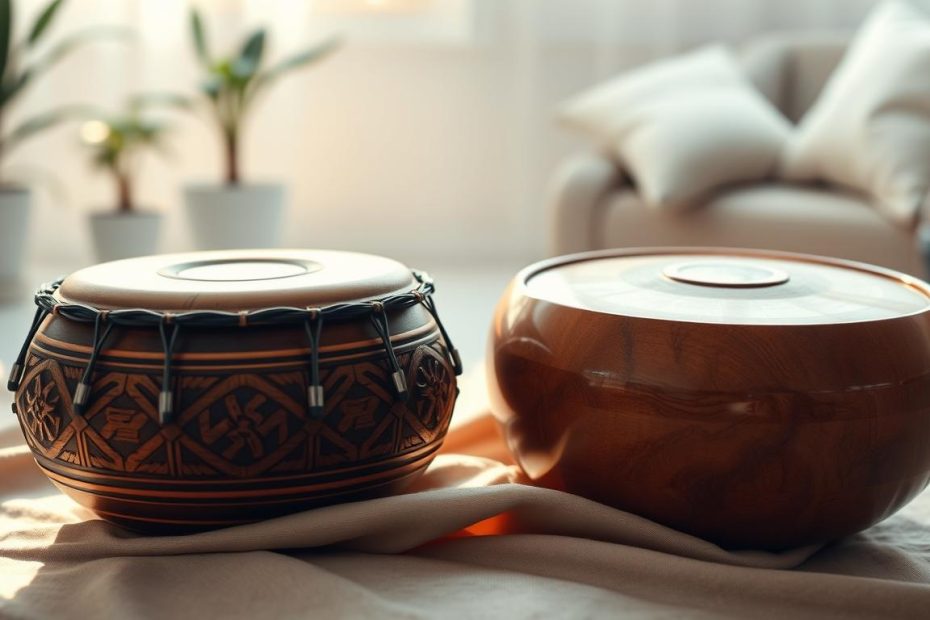
Goal: help you choose between two tuning standards based on how you plan to use your instrument. This short guide explains how relaxation, group playing, or your repertoire can shape your decision.
The comparison covers the character of the sounds and the feel of playing, as well as compatibility with other instruments and the availability of different models. In France, the standard tuning dominates the market, while the alternative associated more closely with well-being is harder to find.
The number of notes and the size of the drum affect tonal clarity, projection, and bass response. Price depends mainly on the number of notes, the brand, and how the instrument is made; tuning can also affect availability.
Next, we explain the basics of frequency, sound differences, perceived effects, and practical ways to try both options and decide. For a detailed comparison, see our complete selection of models and prices.
Why this comparison matters for the way you play today
This tuning choice matters more as musical practices become more varied.
Solo playing, wellness workshops, or ensembles: each setting points toward a different instrument. For musicians who play with others, immediate compatibility often favors the prevailing standard.
For introspective playing or relaxation sessions, however, a less common alternative may appeal because of its sound and the sensations it creates.
The music world favors the prevailing standard: more models, tutorials, and spare parts are available, especially in France. Time matters too: if you may play in a group or resell the instrument later, plan for compatibility.
| Criterion | Effect on playing | Practical consequence |
|---|---|---|
| Compatibility | Group playing | Easy to tune with other instruments |
| Solo use | Meditation, relaxation | Personal preference for tone and listening comfort |
| Scale and notes | Melodic needs | Sometimes more important than frequency alone |
| Availability | Supply in France | Affects waiting times and budget |
The difference you hear also comes down to personal preference. This comparison is not dogmatic: what matters is choosing an instrument that suits your musical plans.
We will look at specific uses in more detail. For now, set your priorities: ensemble playing, solo practice, meditation, or learning songs. For more practical advice, see our buying guide.
Frequency, hertz, and tuning standards: the basics
Understanding frequency helps explain how we perceive the pitch of a note.
A hertz (Hz) measures the number of vibrations per second in a sound wave. The higher the frequency, the higher the sound seems. Human hearing spans roughly 20 Hz to 20,000 Hz, so a difference between tuning references can be audible, though subtle.
What is a hertz, and what does it mean in music?
Hertz describes the physical pitch of a note. On an instrument, each plate or playing area vibrates at a particular frequency. Apps and spectrum analyzers let you see these values in real time.
A4 = 440 Hz: the international standard and what it means
The A4 reference of 440 Hz was adopted in the twentieth century to standardize tuning between instruments and make orchestral playing easier. An alternative reference of about 432 Hz lowers all notes relative to 440 Hz, with an 8 Hz difference at A4.
| Element | Measurement | Practical consequence |
|---|---|---|
| Hertz | Cycles per second | Defines physical pitch |
| Hearing range | 20 to 20,000 Hz | Allows subtle differences to be heard |
| Tools | Tuners and spectrum analyzers | Check a tongue drum’s actual tuning |
| Standard | A4 = 440 Hz | Compatibility between instruments |
These basics explain why an instrument may sound “lower” or “higher.” For a frequency analysis and practical tools, see our dedicated page.
432 Hz or 440 Hz: how do sound and feel differ?
When listening closely, some frequencies may sound softer or sharper. On a melodic percussion instrument, the difference is easiest to hear in a quiet setting.
Perceived tone
432 Hz is often described as enveloping and warm. The notes can seem rounded and pleasant to the ear.
440 Hz tends to sound clearer and brighter. The attack can seem sharper and the sound more defined.
Perceived pitch, tuning, and dynamics
The 8 Hz difference at A4 is small but real: it can affect the tension or ease you perceive in a musical phrase.
Dynamics can feel different too. Some players find the first option more “rounded” on attack and the other more incisive.
- Vibrations in the body of the instrument and the room’s acoustics strongly affect perception.
- Instrument size and the number of notes affect how long sounds resonate and how they interact.
- Try two otherwise identical instruments with different tunings to train your ear.
Tip: trust your own response. Your mood, playing intention, and the instrument’s build quality also matter.
Body and mind: perceived effects and current evidence
The effect of frequencies on the body and mind is drawing increasing attention. Practitioners report feeling calmer during relaxation and meditation sessions.
Relaxation, meditation, vibrations, and well-being
Many people find the vibrations and long resonance of a large instrument conducive to relaxation. The quality of its notes, tuning stability, and how it feels when played by hand matter as much as pitch.
What studies say, and what they do not yet show
Italian studies conducted between 2016 and 2020 reported improvements in perceived anxiety, sleep, and certain vital signs for interventions using an alternative frequency compared with the standard reference.
“The results are promising, but the authors call for larger and more rigorous studies.”
| Element | Observation | Limitation |
|---|---|---|
| Anxiety | Reported reduction | Small samples |
| Sleep | Moderate improvement | Individual variation |
| Physiology | Small changes in vital signs | Replication needed |
Tip: try the instrument in a real setting, paying attention to your breathing and posture, then compare your impressions over several days. A 440 Hz tuning is not inherently stressful; well-being also depends on how you play, the tempo, and tonal clarity. Choose according to your intended use and your own observations.
Start with your needs: playing intention and setting
The starting point is simple: what kind of playing do you want to prioritize?
Meditation, yoga, music therapy, and introspective playing
For meditation, the soundscape matters more than fitting into a group. Guides recommend a warmer tuning and a gentle scale for breathing exercises and yoga nidra.
Choose a larger instrument if you want deep sounds and long resonance. A model with 6 to 8 notes is often enough for intimate sessions.
Ensemble playing, accompaniment, and repertoire
If you play with other instruments, prioritize compatibility and a standard frequency. A model with 11 to 15 notes or more gives you a broader repertoire and makes accompaniment easier.
Try playing with mallets and fingers: the attack changes how the instrument feels, whatever its tuning.
- Define how you will use it.
- Choose a scale for the mood you want: major, minor, or pentatonic.
- Choose the number of notes to suit the music you want to play.
| Criterion | Suggested use | Practical consequence |
|---|---|---|
| Solo playing | Meditation and yoga | 6 to 8 notes and long resonance |
| Group playing | Accompaniment and performance | 11 to 15 notes or more; compatibility with other instruments |
| Portability | Travel and workshops | Smaller instrument, quick patterns |
A simple approach: define your use, then choose the frequency, scale, and finally the number of notes. To explore suitable models, see our beginner selection in the beginner collection.
Tuning, compatibility, and playing with other instruments
Before buying, consider how the instrument will sound with other musicians. Its tuning affects how easily it fits into a group and how you perceive its vibrations.
Playing with instruments tuned to 440 Hz: what to consider
The 440 Hz standard remains the reference for ensembles. Guitars, pianos, and wind instruments are generally tuned to it.
An instrument tuned to a different reference will sound lower in this setting. This can create beats and make the instruments seem out of tune.
Retuning a tongue drum: possibilities and limits
Retuning options are limited. Handcrafted solutions and magnetic systems can make small adjustments to a scale.
Switching from one tuning reference to the other is not realistic without substantial modification. Such work can affect the vibrations and the stability of the notes.
| Element | Effect | Practical consequence |
|---|---|---|
| 440 Hz standard | High compatibility | Preferable for group playing |
| Alternative tuning | Beats with other instruments | Test before planning a live performance |
| Magnetic adjustments | Minor changes | Do not replace proper retuning |
Tip: if your goal is ensemble playing, choose a compatible tuning and check the tuning standard of any accessories. For solo use, you are free to choose another frequency. Always try your instrument with other instruments before buying; see our complete guide.
Model availability, frequencies, and price ranges in France
In France, availability often shapes your budget and expectations.
The majority of instruments sold in France are tuned to 440 Hz. This means more models, scales, and accessories are readily available.
Alternative options and their effect on your budget
432 Hz options exist, but there are fewer of them, and some retailers charge more for them.
- Entry level: around €50 for small, basic models.
- Midrange: around €150 to €200 for standard-quality models with 11 to 15 notes.
- High end: models from established brands can cost more than €700 to €1,000.
Tip: note count, size, and brand affect price more than frequency alone. Prioritize tuning quality, note stability, and tonal clarity over the frequency by itself.
| Criterion | Effect on price | Practical consequence |
|---|---|---|
| Number of notes | High | More notes mean a higher price and a broader repertoire |
| Size and body | Moderate | Better resonance and bass response, at a higher price |
| Brand | High | Reliability and after-sales support, at a premium |
Consider resale too: a 440 Hz instrument will usually be easier to resell in France because it matches the habits of other instrument players.
Before buying, set a budget and choose a reference pitch (440 or 432 Hz), then narrow your choice by scale, note count, and brand. To compare brands and find leading models, see our selection of the best brands.
Scale, number of notes, and size: how they affect your frequency choice
The instrument’s layout, especially its number of notes, determines what you can play and how its sound behaves.
Number of notes, tonal clarity, and interference
More notes give you a wider repertoire and make familiar pieces easier to play.
On a small body, closely spaced notes may interfere with one another. Some players enjoy this layered sound; others prefer a clearer tone.
“On compact models, nearby vibration modes create audible beats.”
Size, depth of sound, and relaxing practices
Larger models produce richer bass and longer resonance. They suit relaxation sessions and meditative soundscapes.
For beginners, major or pentatonic scales are good choices. They make improvisation easier and reduce the chance of discordant notes.
| Criterion | Effect | Advice |
|---|---|---|
| Number of notes | Melodic variety | More notes for playing pieces; fewer for a simple, relaxing practice |
| Size | Depth and resonance | Large model for relaxation; small model for portability |
| Scale | Musical character | Akebono or Hijaz for their distinctive character; major or pentatonic for simplicity |
Test the response to mallets and fingers for the scale and size you choose. Tuning quality is essential to accurate, stable notes and matters at least as much as frequency.
432 Hz or 440 Hz tongue drum: which should you choose?
First decide whether your priority is inner calm or musical versatility.
“Well-being and meditation”: when to favor 432 Hz
Suggested choice: if you use the instrument for relaxation, yoga, or music therapy, a reference pitch perceived as softer may help create a calm atmosphere.
Users report appreciating this tuning for its long, enveloping resonance and its ability to accompany breathing.
“Versatility and group playing”: when to choose 440 Hz
For ensemble playing, accompanying singing, or recording, the standard makes it easier to fit in and reduces tuning complications.
Price and availability: the French market offers a wider choice of models tuned to the standard reference.
Personal preference, your ear, and playing enjoyment
Personal preference remains decisive. Try both options alone and with other musicians.
- Solo playing and well-being: 432 Hz
- Versatile solo playing: 440 Hz
- Groups and live performance: 440 Hz
- Ambient studio work: either can suit the project
Tip: first decide on the number of notes and the size of the instrument, then choose between the two frequencies. Keep a listening journal over several sessions to make a more informed decision.
Practical tips for trying, comparing, and deciding
Nothing replaces trying an instrument in real conditions to check how it feels to you. Try two instruments of the same size and scale so you can focus on the effect of the tuning.
Test alone, then with a group
Play alone first and note the clarity of each note and how long it resonates. Then rehearse with other instruments to assess compatibility and any audible beats.
Check the scale, accessories, brand, and quality
Use a spectrum analysis app to confirm the actual frequency in hertz and spot any tuning drift.
Check the scale (major, minor, or pentatonic), tonal clarity, the balance of the resonance, and whether notes interfere excessively.
“Compare identical models while changing only the tuning; this reveals the frequencies’ actual effect.”
- Try two similar instruments to isolate the tuning difference.
- Play alone, then with other musicians to assess how well the instrument fits in.
- Confirm the frequency with an analysis app.
- Prioritize note count, size, and build quality before accessories.
- Compare prices for equivalent models, sizes, and brands.
- Write down your impressions immediately, then again after a few days of listening.
| What to check | Why | Suggested action |
|---|---|---|
| Compatibility | Playing in a group without unwanted beats | Try it with other instruments before buying |
| Actual tuning | Checking stability | Measure it with an analysis app |
| Quality | Clarity, resonance, and limited interference | Compare equivalent models and brands |
| Accessories | Playing comfort | Buy separately if needed |
Final tip: if you are still unsure, base your decision on how you expect to play in the medium term—alone or with a group—and on your budget. This article gives you a practical way to test your options and decide with confidence.
Conclusion
The best option is the one that makes you want to play.
The two tuning references suit different uses: one appeals to people interested in meditation, while the other suits live performance and compatibility with other musicians.
In France, the standard makes models and accessories easier to find. Frequency matters, but tuning quality, scale, size, and the number of notes affect sound and playing comfort just as much.
A simple method: define how you will use the instrument, choose a frequency and a scale, then decide on the number of notes and your budget. Try it several times in real conditions, and let your body and mind guide your decision.
Tip: listen to demonstrations, arrange a trial, then buy the instrument that will make you want to play more often, now and in the future.